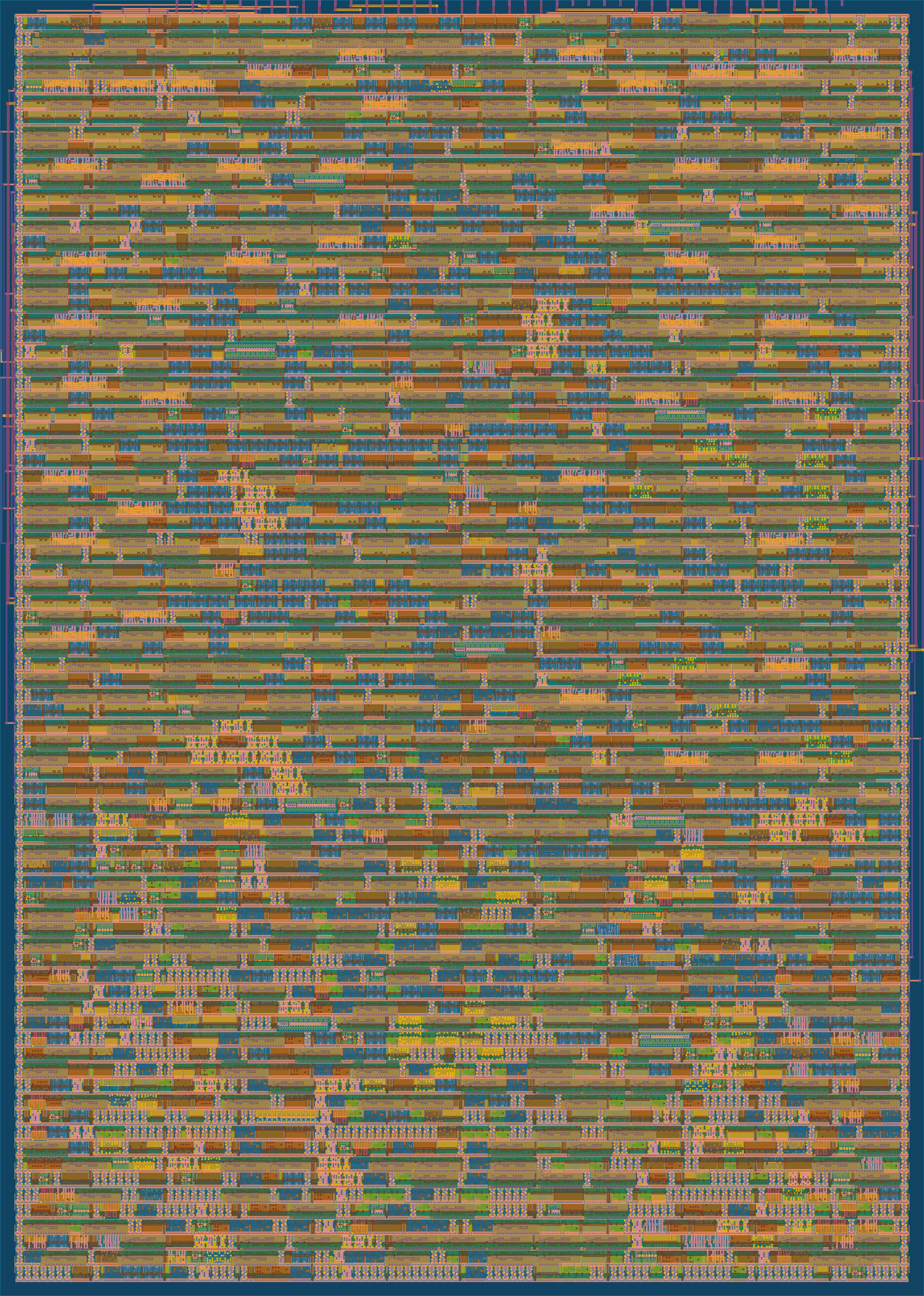
A configurable FIFO-buffered UART with an AMBA APB register block, written in SystemVerilog and hardened on SkyWater SKY130 for the Tiny Tapeout ttsky26c shuttle.
The transmitter serializes each byte behind start and stop bits, with optional even or odd parity. The receiver oversamples the line at 16x, recovers each byte with mid-bit sampling that resynchronizes on every start edge, and flags framing and parity errors. A tick_gen divides the 50 MHz system clock to the baud rate, and a two-flop synchronizer guards each asynchronous input against metastability.
A 16-deep sync_fifo on each path decouples the host interface from the serial timing. tx_push enqueues the byte on ui_in into the TX FIFO, a loader FSM hands buffered bytes to uart_tx whenever the transmitter is ready, and received bytes drain through rx_pop. Both strobes are two-flop synchronized and rising-edge detected, so a pulse of any width moves exactly one byte.
A csr_pin_adapter shifts a 12-bit serial frame in over three pins and drives it as one APB transaction into apb_csr, a register file that controls internal loopback, parity, and a runtime baud divisor, and exposes FIFO and error status.
Every block is exercised through the tile pins by a self-checking cocotb suite, and CI runs the same suite against the hardened gate-level netlist.

| Signal | Direction | Width | Description |
|---|---|---|---|
ui[7:0] |
in | 8 | tx_data, byte to enqueue for transmit (ui[0] doubles as csr_mosi in CSR mode) |
uio[0] |
in | 1 | rx_serial, receive line (idle high) |
uio[1] |
in | 1 | tx_push, rising edge pushes ui_in into the TX FIFO (doubles as csr_sclk in CSR mode) |
uio[2] |
in | 1 | rx_pop, rising edge pops a byte from the RX FIFO |
uio[7] |
in | 1 | csr_mode, hold high to shift a CSR frame in |
uo[7:0] |
out | 8 | rx_data, RX FIFO read data, or CSR read data after a register read |
uio[3] |
out | 1 | tx_serial, transmit line (idle high) |
uio[4] |
out | 1 | tx_full, TX FIFO full |
uio[5] |
out | 1 | rx_empty, RX FIFO empty |
uio[6] |
out | 1 | rx_error, framing or parity error (one-cycle pulse, latched in STATUS) |
Each strobe acts once per rising edge regardless of pulse width. Hold ui_in stable from the tx_push rising edge until a few clocks after release. A popped byte appears on uo_out about six clocks after the rx_pop rising edge and holds until the next pop. Hold both strobes low while reset releases. A strobe already high at release counts as one edge.
The register block is an AMBA APB slave reached serially. With csr_mode held high, the host clocks a 12-bit frame of a read/write bit, a 3-bit address, and a data byte on csr_sclk and csr_mosi, MSB first. The adapter synchronizes the shift clock into the tile domain, assembles the frame, and issues a single APB access. Keep csr_mode high for at least ten clocks after the final csr_sclk rising edge. A read holds its byte on uo_out until csr_mode drops or the next frame starts.
| Addr | Name | Access | Contents |
|---|---|---|---|
| 0 | CTRL |
R/W | bit0 loopback_en, bit1 parity_en, bit2 parity_odd (a write clears the sticky STATUS bits) |
| 1 | STATUS |
R | bit0 tx_full, bit1 tx_empty, bit2 rx_empty, bit3 sticky rx_error, bit4 sticky rx_overflow |
| 2 | SCRATCH |
R/W | 8-bit scratch register |
| 3 | BAUD_LO |
R/W | baud divisor [7:0] |
| 4 | BAUD_HI |
R/W | baud divisor [15:8] |
The baud divisor is clock_hz / baud. At the 50 MHz tile clock, 115200 baud is a divisor of 434, and a divisor of 0 (the reset value) selects the compile-time default of 434. The minimum valid divisor is 16, one clock per oversample point. The receiver rounds the divisor to the nearest multiple of 16 for its oversample period, giving an effective bit rate of clock_hz / (16 * round(divisor / 16)), so keep the divisor within 4% of a multiple of 16. Each frame latches the parity and baud configuration as it starts, and the sticky STATUS bits hold error and overflow events until a CTRL write clears them. Reconfigure the divisor while the link is quiet, writing BAUD_LO then BAUD_HI.
| Suite | Method |
|---|---|
test/test.py |
Self-checking cocotb suite through the tile pins, run at RTL and gate level |
test/csr |
APB register block driven directly + serial-frame round trip through the adapter |
test/uart |
Parity and runtime baud through a uart core loopback |
The top-level suite covers randomized loopback, a data-value sweep, framing and parity errors, a 4% baud mismatch in both directions, start-glitch rejection, back-to-back frames, and every CSR register through the serial frame interface. Strobe handling is checked with held pins, the ui_in hold contract, pops on an empty FIFO, and pops during CSR mode. FIFO behavior is checked with tx_full backpressure, an overflow followed by an in-order drain of the retained bytes, and a mid-frame reset. The suite also covers mid-frame baud writes, the minimum divisor, sticky error set and clear, unmapped addresses, and the CSR mode-exit strobe race.
The gate-level run (make GATES=yes) executes the full top-level suite against the hardened netlist.
A byte pushed into the TX FIFO is shifted out on tx_serial as an 8N1 frame, recovered by the receiver into the RX FIFO, and read back on uo_out.

A serial CSR write shifts a 12-bit frame in on csr_sclk and csr_mosi, and the adapter drives one APB write into the register block.

The fabricated die carries rev A. Rev B upgrades the receiver to decide each bit by a 2-of-3 majority vote across three oversample points straddling the bit center, verified at RTL with sample-point glitch tests and a measured clock-mismatch envelope. Its extra cells exceed the 1x2 tile's routing margin, so rev B stays off silicon.
| Rev | Where | Status |
|---|---|---|
| A | ttsky26c-silicon |
Submitted to the ttsky26c shuttle, on silicon |
| B | majority-vote |
RTL-verified, not fabricated |
Run from test/:
make                             # top-level cocotb suite
make GATES=yes                   # gate-level simulation against the hardened netlist
make -C csr                      # CSR register block in isolation
make -C csr -f Makefile.adapter  # CSR serial adapter plus register block
make -C uart                     # parity and runtime baud
Icarus Verilog 13.0, cocotb 2.0.1, and Verilator for lint. The GDS flow runs LibreLane 3.0.3 on the SKY130A PDK.
The flow hardens the design onto a 1x2 tile, rendered here from the latest build and browsable in the interactive 3D viewer.