
Queueing theory in Python: exact analytical solvers paired with discrete-event simulation — for 50+ models from M/M/1 to multiserver-jobs, RDR priorities, SRPT scheduling, age of information, vacations and queueing networks.







- Analytics and simulation together. Nearly every analytical calculator ships with a paired discrete-event simulator, and the test suite cross-validates them against each other. You get fast exact numbers and a way to check them.
- Models you won't find elsewhere in open source: size-based scheduling analytics (SRPT, SJF, PSJF, SPJF with ML-style size predictions, FB/LAS), M/G/1 vacation models, negative customers (RCS / disasters), unreliable servers, multi-server phase-type systems solved by the Takahashi–Takami method (including CV < 1 via complex-fit H₂).
- Moments, not just means: waiting/sojourn time raw moments, state probabilities,
utilization — with a uniform
set_sources() / set_servers() / run()API across all models. - Pure Python + NumPy/SciPy, pip-installable, MIT license.
pip install most-queueRequires Python ≥ 3.10. For network visualization you may also need the system graphviz package.
from most_queue.theory.fifo.mmnr import MMnrCalc
from most_queue.sim.base import QsSim

# Analytical M/M/3 with a finite queue
calc = MMnrCalc(n=3, r=100)
calc.set_sources(l=2.0)
calc.set_servers(mu=1.0)
theory = calc.run()

# The same system, simulated
sim = QsSim(3)
sim.set_sources(2.0, "M")
sim.set_servers(1.0, "M")
experiment = sim.run(100_000)

print(f"Mean waiting time: theory {theory.w[0]:.3f} vs simulation {experiment.w[0]:.3f}")
# Mean waiting time: theory 0.444 vs simulation 0.448Computed by the library's own calculators — conditional slowdown E[T(x)]/x by job size
for FCFS, PS, FB (blind) and SRPT (size-aware):
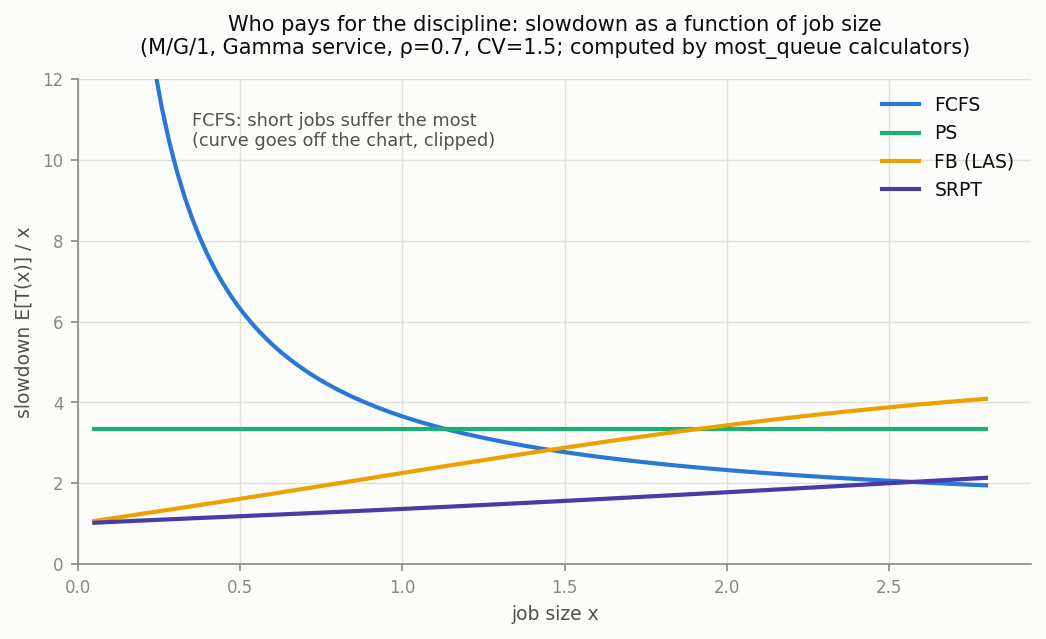
See the executable comparison of 9 disciplines in
tutorials/disciplines_comparison.ipynb.
| Family | Models | Method |
|---|---|---|
| Classic FIFO | M/M/c, M/M/c/r, Erlang B/C, M/G/1, GI/M/c, M/D/c, Eₖ/D/c, M/G/∞ | exact |
| Multi-server phase-type | M/H₂/c, H₂/M/c, H₂/H₂/c (CV < 1 via complex fit) | Takahashi–Takami |
| Size-based scheduling | M/G/1 SRPT, SJF, PSJF, SPJF (with size predictors + graceful-degradation curves), FB/LAS, PS, LCFS-PR | exact (Schrage–Miller, Mitzenmacher) |
| Priorities | M/G/1 PR/NP multi-class, M/G/c PR/NP, M/Ph/c PR; RDR M/M/k & M/PH/k multi-class (exact + RDR-A), per-class response variance; M/M/2 with heterogeneous servers (exact non-birth-death CTMC); accumulating priority (Kleinrock/APQ), priority Erlang-A (impatience), MMAP/PH/1 priorities (NP/PR/RS), retrial with a priority class, preemptive repeat | exact / RDR / CTMC / invariant approximation |
| Multiserver-job (MSJ) | FCFS with phase-type service; general-service FCFS/EASY/conservative, FirstFit, MSF and Quickswap; power-of-two ServerFilling, checkpoint/resume costs and optional useful-service protection | FCFS CTMC / saturated analysis; trace-driven simulation for scheduling policies |
| Load balancing (mean-field) | dispatching over a large pool — power-of-d / JSQ / JIQ / random | mean-field fixed point |
| Polling systems | one server touring Q queues with switchover — exhaustive / gated | pseudo-conservation law (Boxma–Groenevelt) |
| Non-stationary Mt/M/c | time-varying arrival rate λ(t) — blocking & waiting probability | PSA & MOL approximations |
| Age of Information | M/M/1, M/G/1, preemptive-LCFS — average & peak AoI | closed-form + simulation |
| SLA / deadline-violation probability | P(W > D) and SLO quantile from raw moments — works on top of any model in this table; LLM-serving TTFT SLO example |
H2/Gamma tail fit, M/M/1 exact anchor |
| Vacations & warm-up | M/G/1 multiple vacations, N-policy, warm-up/cooling/delay (M/Ph/c) | Fuhrmann–Cooper, Takahashi–Takami |
| Negative customers | M/G/1 and M/G/c with RCS or disasters | exact / Takahashi–Takami |
| Reliability | M/G/1 and M/M/c with breakdowns & repairs, machine repair problem (spares, R repairmen, 2 heterogeneous repairmen), working breakdowns, disasters with a repair phase, retrial with an unreliable server | Avi-Itzhak–Naor / exact CTMC / birth-death |
| Matrix-analytic (MAP/PH) | MAP/PH/1, M/PH/1, PH/PH/1, MAP/M/c, MAP/PH/c — correlated (bursty) arrivals, single- & multi-server; MMPP fitting | QBD, logarithmic reduction |
| Unbounded dynamic batching | All-waiting dispatch; deterministic/exponential/Erlang/gamma/H2 batch durations, affine mean; independent simulator | numerical means with truncation diagnostics |
| Variable-token batching | Output length/max-token clipping; dynamic, fixed and gated elastic service with non-exponential durations; general service callbacks | numerical means; M/G/1 clipping means exact |
| Mixed prefill/decode | Three iteration costs, occupancy-dependent effective chunking, continuous boundary admission, independent token-level DES | exact surrogate occupancy; approximate mean TTFT/ITL |
| SMDP batching control | Wait-next-arrival / launch-size actions; deterministic time/energy; independent unbounded DES | finite overflow optimum, not infinite-queue optimality |
| Heterogeneous bulk service | Type-specific rates, thresholds and capacities; shared FCFS; exact PH W/V | exponential, batch-size-independent service only |
| KV-cache congestion | Deterministic stage dynamics, LPF eviction/restart, finite spectrum and admission cap; independent integer FCFS | fluid linear stability is not open-queue recurrence |
| KV-cache stability | Joint prompt/output lengths, growing KV footprints, constant slots; independent maximal/free-swap simulation | necessary upper and conditional sufficient lower bounds, not an exact threshold |
| Batch Markovian arrivals | BMAP/M/1, BMAP/PH/1 — correlated batch traffic | level truncation |
| Retrial & abandonment | M/M/1 and M/G/1 retrial (orbit), Erlang-A (M/M/n+M) with staffing | exact / Falin–Templeton |
| GI/G approximations | GI/G/1, GI/G/m mean waiting time | Kingman, Krämer–Langenbach-Belz, Allen–Cunneen |
| Batch arrivals & bulk service | Mˣ/M/1 batch arrivals; M/M^[a,b]/1 bulk (batch) service — LLM inference batching, exact N/W moments and tail for any a≤b; general (Erlang- or H2-fitted, CV≤1 or CV≥1) batch-service time with auto-dispatch by CV and batch-size-dependent parameters; Markovian abandonment (MM1/Erlang/H2); c independent servers sharing one queue, incl. batch-size-dependent service |
exact |
| Impatience & closed | M/M/1+M, Engset | exact |
| Delay-dependent service rates | M/M/c whose service rate switches at a threshold on the customer's own experienced delay (slowdown/speedup) — exact waiting-time distribution, density and mean | exact (mixture of matrix exponentials) |
| Busy-server-dependent service rate | GI/M/2 where a lone busy server works at a different rate than when both are busy (helped by the idle one, or slowed down) — exact state, arrival-observed and waiting-time distributions | exact (Bhat 1966) |
| Threshold-controlled service rate | M/M/1 whose rate switches at a threshold on the number in system — exact sojourn and waiting moments, not elementary because arrivals behind a customer change its own service rate | exact (Morrison 1989) |
| Imprecise computation | Mandatory + optional parts under deadlines: answer quality becomes the control variable, not timeliness or admission — exact offline optimum plus online policies scored against it | exact (LP / min-cost flow) |
| Value-based scheduling under overload | Which jobs are worth running when deadlines cannot all be met: 4 priority rules x 3 guarantee mechanisms (12 algorithms), Hit Value Ratio; exact clairvoyant optimum turns it into a true competitive ratio | DES + exact offline optimum (Horn's condition + MILP) |
| Service rate control with decaying value | Job value decays during service; the controller picks how fast to run, trading the cost of speed against the reward still collectable — exact optimal policy, plus monotonicity conditions checkable without computing it | exact DP (Master & Bambos 2015) |
| Bulk service, correlated input, finite buffer | MAP/PH^(a,b)/1/N: bursty non-renewal arrivals and real blocking; exact waiting- and sojourn-time distributions from a tagged-customer phase-type chain, with no transform to invert | exact (matrix-analytic) |
| Queueing-inventory | M/M/1, M/M/c, or c heterogeneous servers (identical, exponential, or per-server Erlang-/H2-fitted service) with stock-consuming service, general (s,S) replenishment (exponential or Erlang-fitted lead time), backordering or lost sales | exact QBD |
| EDF scheduling | Earliest-Deadline-First as the actual service discipline (not post-hoc SLA) | DES-exact, no closed form (open problem) |
| Deadline-aware admission control | Accept/reject at arrival based on own-deadline feasibility (not reordering), Exp(θ) deadline — LLM-serving SLO | exact convergent series (level-crossing functional equation) |
| Parallel service | Fork-Join, Split-Join; exact heavy-tailed (Pareto) max-of-n; heterogeneous branches, series-parallel task DAGs, (n,k)-join over heterogeneous/DAG branches | Markovian / order statistics / exact (Beta function) |
| Networks | open (decomposition, exact Jackson, QNA two-moment flows, MAP input), closed (exact MVA / Buzen / Schweitzer), multi-class BCMP, G-networks (Gelenbe, multi-class), tandems with blocking (finite buffers), fork-join stations, time-varying λ(t), priorities, negative customers, routing optimization | decomposition / product form / MVA |
Every model comes with a plain-language explanation and a diagram in the illustrated model catalog.
- 📖 Documentation — concepts, calculation and simulation guides (English; Russian versions available via in-page switchers)
- 🎓 Jupyter tutorials — counter-intuitive queueing insights for engineers (the utilization trap, why variability dominates delay, multiserver jobs, Age of Information, …)
- 🗺 Development roadmaps & trends surveys — literature-driven gap analysis behind each epic, and what's next
- 🧪 Tests — every model validated against simulation; run with
pytest -m "not slow"
Capacity planning for cloud services and data centers · call-center staffing · manufacturing lines · telecom traffic · healthcare resource planning · scheduling research (SRPT/LAS with ML size predictions).
-
2026-10 — Finite-core infinite TTFT continuation (EPIC-097):
CoreAwareTtftCalcretains exterior excursions and tightens mean intervals. Original48 cases pass; near-critical28/32 versus24/32 previously. The frozen twofold total-state target fails (1/32); low-load auxiliary overhead is reported. Floating means, no verified rounding or GPU/SLO claim. Derivation, ablations and fresh DES. -
2026-10 — Phase-aware stability (EPIC-096):
PhaseAwareStabilityCalcchecks every reachable saturated class with exact rational row drift;PhaseAwareTtftCalcadds floating infinite mean bounds. 48/48 original cases bounded, recovering all 3 prior refusals; critical cases remain unresolved. Proof, frozen grids and independent DES. -
2026-10, current source tree — Infinite stage-aware TTFT (EPIC-095): killed regenerative count kernel with analytic mean/truncation and waiting-tail bounds, evaluated in floating point (not verified rounding).45/48 frozen cases solved;3 sufficient-stability refusals retained. No GPU/SLO claim. Derivation and results.
-
2026-10, current source tree — Exact iid TTFT state reduction (EPIC-094): waiting-count integration and decoder symmetry preserve finite-loss means; all48 previous cases agree, larger-law full-model budget refusals are reported. Mixed-law cases use13x fewer states and run18–27x faster than the full solver. This does not remove finite/infinite bias or support correlated marks. Method and evidence.
-
2026-10, current source tree — Joint-mark replay and stage-aware TTFT (EPIC-092/093): audited BurstGPT API cohorts with exact pair-permutation controls (no confirmed rank reversal on the frozen pair); stage-resolved small-law semi-Markov mean TTFT, exact B=1 PK and explicit finite-loss B>1 limits. Includes independent token oracles and a 48-point grid; not a GPU benchmark or a scalable predictor. Replay results · Calculator and limits.
-
2026-10, current source tree — SMDP batching control (L6 / EPIC-089): deterministic batch times/energies, finite overflow RVI, independent occupation LP and unbounded FCFS DES. Tail drift is checked separately: a small overflow contribution does not certify real-queue stability. Model and limits.
-
2026-10, current source tree — Heterogeneous bulk service (L8 / EPIC-091): exact unbounded geometric/free-period decomposition, waiting/response PH, moments/tails/LST, type flows and independent request-level DES. Published diagonal priority discrepancies are recorded with physical CTMC arbiters. Model and limits.
-
2026-10, current source tree — KV-cache congestion (L5 / EPIC-088): continuous eviction/restart trajectories, homogeneous cycles, finite-input spectrum and rate caps; independent integer FCFS simulation with work/request conservation. Includes rational and exact Schur checks, 48 spectra and 24 paired synthetic DES settings. Model and limits.
-
2026-10, current source tree — KV-cache stability (L4 / EPIC-087): joint-length resource-area bounds, correlation-sensitive capacity and strict replica estimates. Includes independent stage packing/flow checks and 36 synthetic configurations. Free swapping and constant slots are explicit assumptions, not production GPU guarantees. Model and limits.
-
2026-10, current source tree — Mixed prefill/decode (L3 / EPIC-086): Ramani–Tantawi iteration costs, exact infinite-tail surrogate occupancy and approximate TTFT/ITL, with a separate token-level simulator. Includes 96 published-cost predictions, 28 synthetic DES cases and explicit diagnostics for nonphysical mean-field estimates. Model and limits.
-
2026-10, current source tree — Variable-token batching (L2 / EPIC-085): dynamic, fixed and gated elastic queues retain the randomness of output lengths; clipping/utility search, early-release simulation, and general non-affine service callbacks. Includes 36 reproducible configurations and independent checks of the source paper's fixed-batch formula. Model and limits.
-
2026-10, current source tree — Unbounded dynamic batching (L1 / EPIC-084): numerical analysis of Inoue's model with deterministic, exponential, Erlang, gamma and H2 batch durations; moment-aware truncation diagnostics, published latency bounds, and an independent event simulator. Includes a reproducible 60-point comparison and checks against closed forms and capped-batch CTMCs. Mean delays only, not analytic tails. Model and limits.
-
2026-10, current source tree — Exact SLA tail for batch-service queues:
get_tail/get_cdfgive the exact (not moment-fitted, not an upper bound)P(W>D)for GPU/LLM-style bounded-window batch service with phase-type (Erlang/H2, any CV) processing time, via sparse matrix-exponential-action. Quantified against Inoue (2021)'s closed-form mean-latency bound (a bounded window can push true E[W] up to ~10x above it) and against the library's own moment-fit SLA approximation (which overestimates deep-tail violation probability by orders of magnitude). 19 new tests, DES-validated. Method, results. -
2026-10, current source tree — Bulk service with correlated arrivals and a finite buffer: MAP/PH^(a,b)/1/N (catching up with the literature, item R9; this closes the whole R1-R9 series): the model of Banik, Chaudhry, Barik & Singh, JISPS 26 (2025) 585-630, whose own title calls its procedures heuristic. Both that paper and its open-access Poisson predecessor (Chaudhry et al., Mathematics 11(5):1142, 2023) reach the waiting time through a transform and then invert it with a Pade approximation; the transform is exact, so the approximation lives entirely in the inversion. This implementation never forms one: it follows a tagged customer through an absorbing chain and reads the waiting time off as a phase-type distribution. A compression keeps that chain at O(N*a) rather than O(N^2) -- the position falls by exactly b per batch, and the count of customers behind the tagged one only ever matters up to a-1. The published CDF tables reproduce to the six digits they are printed to; where they do not, each disagreement gets an arbiter. The paper's second moment (2.093599) is 0.55% from the exact 2.105153, which is Medhi's published value and which this library's independent infinite-buffer solver confirms to seven digits -- their Pade fit is constrained to reproduce the mass and the mean and nothing else. Separately: assuming PASTA under a MAP costs +45% on E(W), a modelling error rather than an approximation. Model.
-
2026-10, current source tree — Service rate control for jobs with decaying value (catching up with the literature, item R8; this closes the adjacent-communities sub-series): implementation of Master N. & Bambos N., Service rate control for jobs with decaying value, ACC 2015. The library's first model where the answer is a control policy rather than a performance measure: a server works through a fixed batch, the head-of-line job loses value with every slot it fails to complete and is thrown away once that value runs out, and the only lever is how fast to run. The dynamic program collapses -- the optimal rate depends on the state through a single scalar -- so it solves in O(BV|S|). All four panels of the paper's figure 1 and its three monotonicity theorems are reproduced as tests, including conditions that decide how the policy behaves without computing it. Validated against a value iteration that does not assume the state space is acyclic, against a slot-by-slot simulation, and against hand-computed closed forms. Found along the way: a myopic rule can cost more than not adapting at all (461.9 against 279.8 optimal, losing to a fixed rate at 291.4), because it drops the look-ahead term that dominates the signal and grows with the backlog. Model.
-
2026-10, current source tree — Value vs. deadline scheduling under overload (catching up with the literature, item R7): implementation of Buttazzo G.C., Spuri M. & Sensini F., Value vs. deadline scheduling in overload conditions, RTSS 1995. Once the load passes one, EDF does not merely lose optimality -- it collapses, serving the most urgent job while it and several behind it are already doomed. Each job carries an importance value, banked in full only if it meets its deadline. All twelve of the paper's algorithms (EDF/HVF/HDF/MIX priority x plain/guaranteed/robust guarantee), its task-set generator, and all four of its published observations reproduced as tests -- including the crossover where RHDF overtakes REDF past nominal load 3. Added on top, and not in the paper: the exact clairvoyant optimum, via Horn's feasibility condition turned into an integer program, which fixes the paper's denominator and shows REDF banking 94% of the achievable value at nominal load 3 where its raw Hit Value Ratio of 0.864 looks far more modest. Validated against exhaustive search whose feasibility test is a preemptive-EDF run rather than Horn's condition, so the reference is independent of the formulation under test. Model.
-
2026-10, current source tree — Imprecise computation / controllable processing times (catching up with the literature, item R6; the first of the adjacent-community items): implementation of Shih, Liu, Chung & Gillies 1989 and the algorithms of Shih, Liu & Chung 1991 and Shih & Liu 1995, as reviewed by Shioura, Shakhlevich & Strusevich, EJOR 2018. Under overload a system can give up timeliness, admission, or answer quality -- and the third was missing from this library. Each job has a mandatory part that must finish and an optional part that may be truncated; the unexecuted remainder is its error. Exact offline optimum for the total, maximum and lexicographic weighted error, with the schedule emitted and independently re-checked, plus online policies scored against that optimum on the same jobs. Validated against exhaustive search and against the min-cost-flow formulation the literature itself states. Model.
-
2026-10, current source tree — M/M/1 with a threshold-controlled service rate (catching up with the literature, item R5, and completing that sub-series): implementation of Morrison J.A., Sojourn and waiting times in a single-server system with state-dependent mean service rate, Queueing Systems 4:213-235, 1989. The server runs at a low rate until the backlog crosses a threshold
Kand at a high rate above it. The queue length is an elementary birth-death chain; the sojourn time is not, because the rate depends on the total in system including arrivals behind the tagged customer, so its own service can speed up for reasons that affect it in no other way -- which is exactly why Little's distributional law fails here. Exact sojourn and waiting moments, conditional and unconditional. This also closes a limitation our own EPIC-073 and EPIC-078 had stated explicitly. Validated against the M/M/1 reductions, the published stationary distribution, Little's law, and an explicit matrix solve of the same absorbing chain with no boundary condition at all. Model. -
2026-10, current source tree — GI/M/2 with a busy-server-dependent service rate (catching up with the literature, item R4): implementation of Bhat U.N., The queue GI/M/2 with service rate depending on the number of busy servers, AISM 18:211-221, 1966. Real servers are not independent — a lone worker may be helped by an idle colleague or may slow down — and an ordinary GI/M/2 cannot express that. Exact queue-length distribution, the (different) arrival-observed distribution since PASTA does not hold for renewal input, and the full waiting time. Two things not in the paper fall out of the derivation: the state dependence changes how OFTEN a customer waits but not how long once it does (the decay rate
2mu(1-gamma)never mentions the lone-server rate), and stability is decided by the both-busy rate alone. Checked against the paper's published table, the elementary birth-death chain at arbitrary rate ratio, an exact CTMC, and simulation. Model. -
2026-10, current source tree — Higher sojourn moments in M/G/1 processor sharing (catching up with the literature, item R3): implementation of Yashkov's recursion (arXiv:math/0512281, 2005), closing a gap this library's own
MG1PSCalchad been documenting. The mean conditional sojourn timex/(1-rho)is famously insensitive to the service-time distribution; nothing above it is, so a capacity or SLO decision taken on the mean alone carries no information about risk. Exact conditional moments, variance and CV, unconditional moments, andKpermanent jobs sharing the processor. Yashkov concluded the exact expressions were impractical to compute and the literature answered with bounds — that difficulty disappears for phase-type service, where the whole chain stays phase-type and the moments come out of a few small matrix exponentials with no quadrature. Validated against the insensitivity theorem (machine precision, through a recursion never told it), an M/M/1-PS closed form, Yashkov's own small-job asymptotic, his equation (3.10) by independent quadrature, and simulation. Model. -
2026-10, current source tree — Delay-dependent service rates (catching up with the literature, item R2): implementation of D'Auria, Adan, Bekker & Kulkarni, An M/M/c queue with queueing-time dependent service rates, EJOR 299(2):566-579, 2022 — the service rate a customer gets depends on the delay that customer experienced, which is the empirically observed "slowdown" effect in health care, call centres and retail. Exact waiting-time distribution, density and mean, as a mixture of matrix exponentials. The model and solution are the authors'; ours is the implementation, validated against the Erlang-C reduction (
1e-16), their ownc=1closed form (3e-16), their publishedc=2numbers (every printed digit) and independent simulation. Two numerical properties of the method that the paper does not state are documented and handled. Model. -
2026-10, current source tree — Occupancy-dependent continuous batching: exact waiting-time distribution (moments and tail, not just the mean) for the Markovian core of LLM-serving "continuous batching" — up to
krequests served concurrently with a per-request rate that depends on current occupancy, capped by accelerator memory (KV-cache). Occupancy is pinned at the cap whenever anyone waits, soWis an exact, closed-form mixture of Erlang distributions — no sparse solve needed. Regresses exactly to the classicalM/M/k/Nqueue at a constant rate; DES-validated. A simple approximation that ignores the occupancy dependence is shown to overstate deadline-violation risk by 1-2 orders of magnitude at moderate occupancy and several orders of magnitude at a large concurrency cap. Model. -
2026-10, current source tree — Idle-refill, impatience, and multiserver bulk-service: three further generalizations of the bounded-window batch-service model — exact W moments/tail for any idle-refill race
a<=b(not justa=1); Markovian abandonment (gamma-rate reneging) for MM1/Erlang and H2-branching service, each via a dedicated absorbing chain tracking surviving-ahead-count and new-arrivals-behind as explicit state; andcindependent servers sharing one FCFS queue, including batch-size-dependentmuatgamma==0and abandonment at constantmu. All DES-validated independently of the production code; dependent-mucombined with abandonment remains an explicit reserve. See the epic registry for the full breakdown (EPIC-067 through EPIC-072). -
2026-10, current source tree — Availability-aware arrival history: removes a completed-prefix staleness artifact (prefix lag up to 8.2 days) by building arrival-mark donor history from submit<cutoff over the already- parsed completed+cancelled(+failed/timeout/node_failed) population, not stalling at the first job unresolved at cutoff. Lag drops to minutes/hours and the donor pool roughly doubles, but this is not a uniform accuracy win: queue-error effects go in opposite directions on SDSC versus Kalos. 16 unit tests, 792 schedules, byte-identical repeat, independent audit. Method, results.
-
2026-10, current source tree — MSJ capacity calendar: opt-in time-varying capacity (
CapacityCalendar/run_capacity_calendar) over MSJ replay, with automatic grandfathering, explicit infeasible/unresolved outcomes bounded by the calendar's own horizon, and detected (not silently absorbed) reservation/calendar mismatches. 23 unit tests, plus three prescribed Helios scenarios (fixed/daily/isolated-VC pool) over one prescribed window, byte-identical repeat and an independent check. Method, results. -
2026-10, current source tree — Resource observability audit: six source schemas compared; all 3,362,981 Helios records audited with pinned inputs, a byte-identical repeat and independent accounting checks. Daily VC GPU counts support bounded capacity scenarios, not reconstructed hard quotas: 17,459 GPU records start with a zero same-day VC count. No scheduler replay claimed. Method, results.
-
2026-10, current source tree — Joint marked arrivals: empirical gap/K/context/request tuples, circular blocks and matched shuffles, with a common coarse S|K mechanism and fixed-arrival baseline. 1176 empty-start replays and a byte-identical repeat show no consistent joint-generator gain; resolved-prefix staleness and late workload-mix drift remain explicit limitations. Protocol/API, results.
-
2026-10, current source tree — Queue-aware service selection: 1500 replays with two early selection and two late evaluation blocks per source. Queue-selected SDSC request bins improve point uncapped queue-loss versus CRPS selection, but not versus fixed coarse; Kalos type candidates coincide on late service tapes. Class coverage, timeout rates and policy regret remain separate checks. Protocol/API, results.
-
2026-10, current source tree — GPU resource envelopes: prescribed GPU-pool versus exclusive-node capacity sensitivity, with fixed target IDs and explicit infeasible cells. Requested GPU work and reserved GPU-equivalent work remain separate; no quota or placement estimation is claimed. 1080 replays and a byte-identical repeat; observed p99 ties all six policies in every feasible cell, so zero regret does not validate scheduler choice. Protocol/API, results.
-
2026-10, current source tree — Feature-conditional service: 450 paired replays with early-validation model selection. Requested-time ratios reduce SDSC test CRPS by 46.69% and excess timeouts, but do not preserve p99 policy choice; retrospective Kalos type features degrade on the late holdout. Protocol/API, results.
-
2026-10, current source tree — Modern GPU-trace validation: hash-pinned Acme/Kalos ingestion recomputes execution from end-start; the released
durationincludes waiting. 1224 replays with separate failed/cancelled occupation and an identical full repeat. At nominal GPU-pool capacity all observed target waits are zero, so tied policy choices do not validate a scheduler. Service-model errors remain large. Protocol/API, results. -
2026-10, current source tree — Initial state and terminal outcomes: opt-in MSJ replay with running/waiting carry-in, labelled cancelled occupation and start-relative hard runtime budgets. Successful completion, cancellation and timeout are accounted separately; shortened terminal latency is not treated as successful service. The real-trace study keeps a fixed completed target cohort and explicitly excludes cancellations with unobservable resource use. In 1632 replays, adding observed cancelled occupation changed the best mean-delay policy in one period; both service models missed the p99 winner in all four. Protocol/API, results.
-
2026-10, current source tree — Temporal history and dependent service: four prespecified SDSC SP2 origins, seven workload variants and 1368 replays. Recent coarse-group empirical history reduced aggregate mean-delay error from 94.57% to 44.12%, but helped neither every period nor every finer model. Rank blocks reproduced more serial correlation without a consistent delay or p99-decision advantage. These are selected-cohort diagnostics, not causal production guarantees. Protocol, results.
-
2026-10, current source tree — Real-trace service calibration: audited, hash-pinned SDSC SP2 ingestion; completed-history temporal holdout; empirical, Exp, PH and lognormal service compared under six existing MSJ disciplines. In 594 replays, all four models preserved the best mean-delay choice but substantially underestimated delays in the first two blocks; p99-based choices differed from observed-duration replay. This is a selected historical completed-job cohort, not a production-cluster reconstruction. Protocol, results.
-
2026-10, current source tree — MSJ beyond exponential service: small-system PH-FCFS analytics and common-trace experiments for backfilling and prediction-free packing. Runtime forecasts support historical features, resource-group calibration and age-aware Kaplan–Meier estimates from censored history. MSFQ is one-or-all; ServerFilling is a separate power-of-two, zero-cost preemptive-resume model.
MsjCheckpointSimseparately models resource-holding checkpoint/resume phases and reports productive utilization. Optionalmin_service_timeprotects each useful episode; protection can be selected on independent historical replays, without test-set tuning. In 832 paired sensitivity runs, overhead could erase the packing advantage; the crossover depended on workload, not a universal cost threshold. A further 1920-run protection study found gains over unprotected SF at high overhead; zero protection was the historical choice at both lower cost levels. Methods and API, packing results, checkpoint-cost results, protected-service results, roadmap. Simulation comparisons are not new analytical stability or SLO guarantees; PyPI releases may lag this tree. -
2026-09 — Realism wave, part 2: Erlang everywhere, batch-size-dependent params, exact moments: queueing-inventory replenishment lead time generalized from
Exp(θ)to Erlang-fitted (the phase dimension only applies where an order can be in transit — a first for this phase-type family); the per-server heterogeneous model gained an Erlang-fitted (CV≤1) service sibling to its H2 case, with a real outflow-splitting bug (departure vs. mid-service phase-advance rates) caught via a deliberately non-degenerate regression check; bulk-service batch-service parameters (Erlang and H2) can now depend on batch size (LLM/GPU dynamic-batching realism), and the Erlang-fitted case gained exact raw moments of W (not just the mean), extending EPIC-032's PASTA technique to the phase-augmented CTMC. See the epic registry for the full breakdown (EPIC-040 through EPIC-043). -
2026-09 — Realism wave: heterogeneous branches, general service, admission control: fork-join generalized to heterogeneous branches, series-parallel task DAGs and (n,k)-join (exact order-statistics moments, closed-form Pareto); bulk-service batch-service time generalized from exponential to Erlang (CV≤1) and H2 (CV≥1) phase-type fits, with exact N/W moments and an auto-dispatcher picking the family by CV; exact deadline-aware admission control (accept/reject at arrival based on own-deadline feasibility, Exp(θ) deadline — solved via a level-crossing functional equation and truncated power-series moment extraction, after an initial "obvious" shortcut was proven wrong); and queueing-inventory generalized to
cheterogeneous servers (state-splitting + stacked-boundary QBD) with, going one step further, per-server H2-fitted (non-exponential) service time — each server can have its own realistic service-time distribution instead of a single shared rate. See the epic registry for the full breakdown (EPIC-030 through EPIC-039). -
2026-09 — Priorities, inventory & scheduling wave: M/M/2 priorities with heterogeneous servers (exact non-birth-death CTMC, canonicalized state construction); queueing-inventory generalized to lost-sales, the full (s,S) reorder-point policy (not just (0,S)), and M/M/c multi-server stock-sharing (exact QBD via a stacked boundary superblock, reduces exactly to M/M/1 at c=1); and EDF (Earliest Deadline First) as an actual service discipline rather than a post-hoc SLA metric — deliberately DES-only, since exact finite-state EDF analysis turned out to be a genuinely open problem (four candidate exact reductions were tried and numerically/analytically disproven; see
docs/research/edf-scheduling-2026.md). -
2026-09 — SLA & exact-extensions wave: a horizontal SLA/deadline-violation probability layer (
P(W > D)and SLO quantiles from raw moments, on top of any calculator in the table above — LLM-serving TTFT SLO example); exact heavy-tailed (Pareto) fork-join (closed-form max-of-n via the Beta function, no approximation); machine repair with two heterogeneous repairmen (Krishnamoorthi's non-birth-death CTMC technique); and the first queueing-inventory system (M/M/1 with stock-consuming service, (0,S) replenishment, backordering — an exact QBD, reusing the MAP/PH stack's solver). See the research folder for the literature review behind each. -
2026 — Scale & dynamics wave: load balancing in the mean-field limit (power-of-d / JSQ / JIQ — the "power of two choices" behind modern dispatchers); polling systems (one server touring Q queues with switchover, exhaustive/gated, the Boxma–Groenevelt pseudo-conservation law); and non-stationary Mt/M/c with time-varying load (PSA & MOL approximations for surging demand — call-center staffing, autoscaling). Each with a paired simulator and tests. See the trends survey.
-
2026 (v2.9) — Datacenter & multi-priority wave: RDR for multi-server multi-class preemptive priorities (M/M/k and M/PH/k, exact + RDR-A, per-class response-time variance); the multiserver-job model (jobs holding several servers at once — FCFS response time and saturated-system stability, the first open-source implementation); Age of Information (average & peak AoI); bulk-service queues for LLM inference batching; and graceful-degradation curves for prediction-based scheduling. See the trends survey.
-
2026 — Matrix-analytic MAP/PH stack: PH distributions and MAPs (
most_queue.random.map_ph), a QBD solver with logarithmic reduction, and exact calculators for MAP/PH/1, M/PH/1, PH/PH/1, MAP/M/c, MAP/PH/c, plus BMAP/M/1 and BMAP/PH/1 for batch arrivals and MMPP fitting from data; MAP and PH sources in the simulator. Plus retrial queues (orbit) and Erlang-A abandonment with a staffing helper. Seetutorials/map_ph_correlation.ipynb. -
2026 — Wave of exact classics: Erlang B/C, M/G/∞, GI/G approximations, M/G/1 vacation models (multiple vacations, N-policy), PS, LCFS-PR, FB/LAS, unreliable server — each with a paired simulator and tests. Illustrated model catalog with generated diagrams.
-
2026 — Size-based scheduling analytics: SRPT / SJF / PSJF / SPJF with prediction models (reproduces the Mitzenmacher–Shahout 2025 table in tests) +
SizeBasedQsSim. -
2026 (preprint) — Multi-server queues with negative customers via Takahashi–Takami: preprint & reproduction code.
-
2025 (paper) — Multi-channel system with warm-up, cooling and cooling delay: Lokhvitsky, Khabarov, Yakovlev, DOI 10.25791/aviakosmos.1.2025.1456.
Issues and pull requests are welcome! Open an issue for bugs or model requests. Development conventions: docs/PROJECT.md, definition of done: docs/DOD.md.
If you use Most-Queue in research, please cite it (see CITATION.cff):
@software{most_queue,
  author  = {Khabarov, Roman},
  title   = {Most-Queue: queueing theory calculations and simulation in Python},
  url     = {https://github.com/xabarov/most-queue},
  doi     = {10.5281/zenodo.21268402},
  license = {MIT}
}MIT © Roman Khabarov