

Staff Architect · I make AI agents safe to write to financial systems of record.
13+ years building ledger-grade distributed systems at SAP scale.
Now applying the same core invariants — idempotency, sagas, transactional outbox, scoped credentials, and evaluation gates — to agentic AI.
Start here
- 📄 Whitepaper: E2A — Harmonizing the Frontier
- 🗺️ Pattern Map: Frontier AI Concept → Distributed Systems Pattern → Cloud Service Matrix
- ✍️ Core Thesis: Why Agentic AI Makes Application Modernization Mandatory
- 🧪 Architecture Breakdown: Context, Harness, and Evals: What the AI-Assisted SDLC Can Borrow from Distributed Systems
Thesis. An LLM cannot safely navigate tightly coupled legacy state machines. It requires clean, deterministic boundaries — so agentic AI makes application-level modernization structurally mandatory. E2A, A2C, P0, and G2C enforce those boundaries in code, not in prompts.
Rather than replacing cloud-native platforms, this architecture acts as an Enterprise Bridge connecting frontier intelligence to mission-critical ledgers:
┌────────────────────────────────────────────────────────────────────────┐
│ 1. PLUGGABLE COGNITIVE LAYER (Claude, GPT-4o, Gemini, Open-Weights)     │
└───────────────────────────────────┬────────────────────────────────────┘
                                    ▼
┌────────────────────────────────────────────────────────────────────────┐
│ 2. ENTERPRISE CONTROL PLANE & GOVERNANCE BRIDGE (E2A / A2C / P0 / G2C) │
│    • AST Workspace Scaffolding (P0)    • Typed Contract Synthesis (G2C)│
│    • Pre-Commit Eval Gates (A2C)       • Transactional Outbox & Saga   │
└───────────────────────────────────┬────────────────────────────────────┘
                                    ▼
┌────────────────────────────────────────────────────────────────────────┐
│ 3. HYPERSCALER RUNTIMES & SYSTEMS OF RECORD (AWS, GCP, Azure, SAP Core)│
└────────────────────────────────────────────────────────────────────────┘
| Stakeholder Lens | Enterprise Operational Risk | Architecture Solution |
|---|---|---|
| Chief Architect & VP Eng | Proprietary AI vendor lock-in | Hexagonal Architecture: Cognitive models sit behind standardized, pluggable interfaces. |
| CISO & Chief Risk Officer | Non-deterministic write drift |
Deterministic Gates: Programmatic AST validation and RAGAS faithfulness ( |
| FinOps & Cloud Economics | Runaway agentic token burn |
AST Context Pruning (P0): Strips syntactic noise to optimize context window utilization. |
| SRE & Operations | Partial writes & state corruption |
Saga Orchestration: |
Same pattern set, different runtime. OData → FastAPI · BDEF → BaseAgent · CDS entity → AgentState.
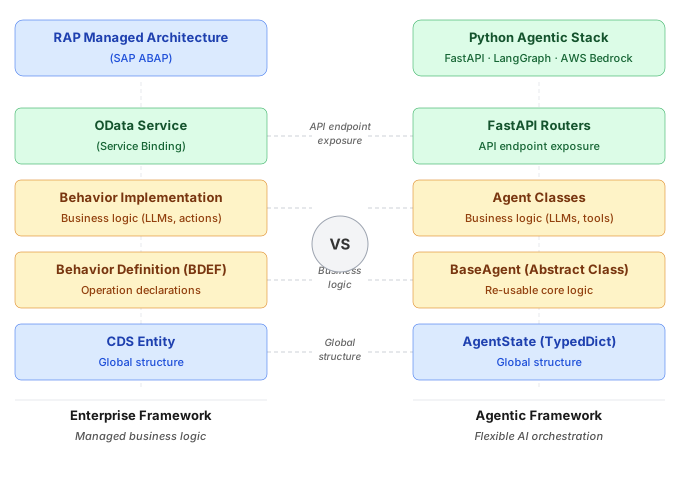
Financial integrity at enterprise scale stems from making invalid states architecturally impossible, not from defensive prompt engineering. Idempotency, lineage, and reconciliation are business features.
| Enterprise Mechanism | What It Enforces | Cloud-Native / Agentic Equivalent |
|---|---|---|
| Deterministic charge-to-settlement key | Revisions are updates, never duplicates | Redis SETNX fast path + DB unique constraint · DynamoDB conditional write |
| "Completely invoiced" business gate | No ledger posting before status confirmed | SettlementState.COMPLETED as the only pre-condition for a ledger write |
| Dispute workflow | Charge-delta mediation as a business process | Policy-grounded reasoning agent + critic groundedness gate |
| Write-once finance ledger | Immutable source of truth | Double-entry unique index; reversal-only corrections |
A cohesive architectural methodology designed to translate high-level enterprise governance, security, and NFRs into deterministic code boundaries:
| Framework | Architecture Scope | Core Invariant Enforced | Repository |
|---|---|---|---|
| E2A (Enterprise-to-Agentic) | Runtime Governance | Invariant lifecycle execution via single entry point; pre-compute validation gates | e2a-framework |
| A2C (Architecture-to-Code) | Modernization Engine | Injects operational NFRs, schemas, and CI/CD policies directly at code generation | a2c-framework |
| P0 (Phase Zero) | Ingress & Scaffolding | Zero-drift workspace bootstrap with pre-wired telemetry, auth, and contract harnesses | in a2c-framework |
| G2C (Generate-to-Class) | Model Compiler | Compiles declarative architecture specifications into typed, contract-bound classes | in a2c-framework |
Concrete runtimes proving the framework's deterministic boundaries and enterprise invariants across heterogeneous stacks:
- order-to-cash-agentic-ai: Multi-agent coordination (Python, LangGraph, Bedrock, OpenSearch) featuring 5-agent bounded context isolation, hybrid RAG retrieval, and critic faithfulness verification.
- aws-reconciliation-engine: Serverless reconciliation system (Python, Lambda, DynamoDB, SQS) enforcing two-layer idempotency gates, atomic state updates, and dead-letter queue escalation.
- financial-settlement-platform: Distributed settlement engine (Java 21, Spring Boot 3, Kafka, PostgreSQL) validating Saga orchestration with reverse compensation, transactional outbox CDC, and double-entry immutable ledgers.
Framework abstractions are cloud-agnostic by design. Reference implementations demonstrate distributed patterns across serverless and open-source stacks, with Azure and GCP landing-zone equivalents documented in the pattern map.
| Framework Concept | Cloud Equivalent | Enforced By |
|---|---|---|
| Abstract class | Landing-zone account / VPC | Control Tower account factory / Azure Landing Zone |
_apply_policy() |
SCP + policy gate | Runs before business logic execution |
@abstractmethod NFR |
Required NFR contract | Container task definition fails without /health |
| CriticAgent | Evaluation gate in CI/CD + SLO alarm | Deployment or completion blocked below threshold |
| Public entry point | API Gateway + ALB | Single ingress boundary |
| → Full reference |
- 35 → 7 min month-end batch runtime (≈80% reduction) across 10,000+ daily freight documents with zero business disruption.
- Ledger-Grade Integrity: Designed exactly-once posting invariants and automated reconciliation engines across high-volume financial settlement batches.
- Mission-Critical Production Ownership: Lead escalation architect for complex enterprise incidents, resolving tier-1 production blockers across global deployments.
Principal / Staff platform-architecture roles in agentic AI infrastructure, enterprise solutions architecture & strategic customer workloads — Anthropic, AWS, Microsoft Azure, Google Cloud.
Trademarks: AWS, GCP, Azure, Meta Llama, SAP belong to their owners; used for architectural reference only. Third-party technologies named here (LangGraph, Pinecone, Lakera) are non-affiliated open-source or commercial products.