
Deterministic context compression for LLMs. Cut JSON tokens by up to 68% with exact recovery, or exceed 90% with opt-in, recoverable pruning.
Tokenfold Core delivers model-free structural compression.
Tokenfold Select ranks the context that matters most when token budgets get tight.



- Installation
- How it works
- Quick start
- MCP & agents
- Core
- Select
- Benchmarks
- Extended tooling
- Safety and auditability
- Reproduce the results
- Contributing
- License
pip install tokenfold        # Python library
npm install tokenfold        # Node.js / TypeScript library
cargo install tokenfold-cli  # Standalone CLI
cargo add tokenfold-core # Rust library|
Up to 96.3% fewer tokens (showcase) Opt-in, recoverable pruning for heterogeneous array feeds - every dropped row stays fetchable. |
45.6-67.6% on three fixtures, lossless Reversible structural folding of repeated keys and columns on three bundled fixtures - verified by exact JSON-value recovery. |
Model-free & deterministic No GPU, no semantic guesswork, no model in the Core path. Validate folded payloads on your workload: exact decode proves data recovery, not unchanged model behavior. Provider-neutral by design. |
Note
Built for: Developers and AI teams cutting latency and API costs on structured JSON, tool definitions, and RAG feeds. Exact decode proves data recovery, not unchanged downstream task accuracy - validate folded payloads with your representative workload. Ideal for applications sending large JSON tool payloads, tool-calling agent loops (Claude Code, Codex), and structured RAG feeds where token overhead drives latency and cost.
// Input (conceptual illustration - 2 rows shown; small inputs like this
// pass through unchanged under the never-larger guard)
[{"id":1,"role":"admin"},{"id":2,"role":"member"}]

// Tokenfold output on larger uniform arrays -> still JSON
{"__tf_cols__":["id","role"],"__tf_rows__":[[1,"admin"],[2,"member"]]}
%%{init: {"theme": "base", "themeVariables": {"primaryColor": "#22D3EE", "primaryTextColor": "#0b1020", "primaryBorderColor": "#A855F7", "lineColor": "#A855F7", "fontFamily": "ui-sans-serif, system-ui, sans-serif"}}}%%
flowchart LR
In["Repeated keys in every record<br/>id, role, id, role"] --> TF[Tokenfold Core]
TF --> Out["Keys named once as columns<br/>values packed into rows"]
Send the folded JSON directly to the model: column names label each value's position in every row. Decode only when your application needs the original object shape again.
- Targets structured JSON, not prose. Folds repeated keys and columns mechanically rather than using semantic guesswork.
- Model-free and deterministic. Zero models running in Core and zero GPU overhead. Exact decode proves data recovery, not unchanged model behavior.
- Verified by exact decode. Every lossless transform is verified by an in-memory round trip before emitting; lossy pruning is strictly opt-in and recoverable.
For tabular arrays, Tokenfold folds repeated keys into
header columns (__tf_cols__). No model runs in the Core engine, and every
lossless transform is verified by exact decode.
Note
schema_compaction is not enabled by any preset. Unlike the default
transforms, it truncates examples arrays and is not reversible.
%%{init: {"theme": "base", "themeVariables": {"primaryColor": "#22D3EE", "primaryTextColor": "#0b1020", "primaryBorderColor": "#A855F7", "lineColor": "#A855F7", "fontFamily": "ui-sans-serif, system-ui, sans-serif"}}}%%
flowchart LR
    App[Application / Agent] -->|Large JSON / tool schemas| TF[Tokenfold Core]
    TF -->|Lossless structural JSON| LLM[LLM provider]
    LLM -->|Completion / action| App
    TF -.->|Optional exact decode of folded payload| App
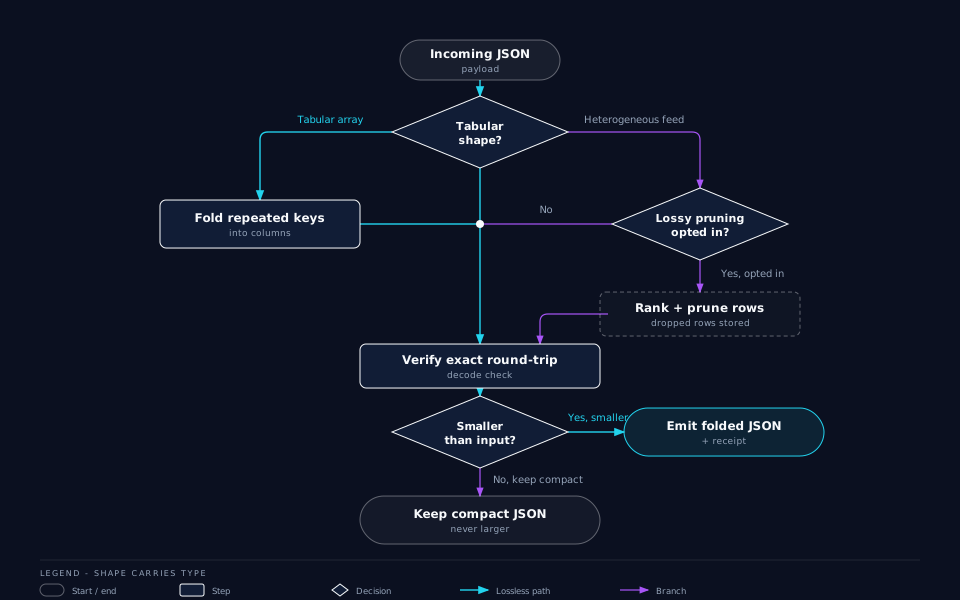
Text version (screen readers / no-image fallback)
- Incoming JSON payload arrives.
- Tabular shape? Yes: fold repeated keys into columns. No (heterogeneous feed): continue only when lossy pruning is opted in (rank rows, store dropped rows locally).
- Verify with an exact decode round trip.
- Smaller than input? Yes: emit folded payload + receipt. No: keep compact JSON (never larger).
%%{init: {"theme": "base", "themeVariables": {"primaryColor": "#22D3EE", "primaryTextColor": "#0b1020", "primaryBorderColor": "#A855F7", "lineColor": "#A855F7", "actorBkg": "#22D3EE", "actorTextColor": "#0b1020", "actorBorder": "#A855F7", "signalColor": "#A855F7", "signalTextColor": "#334155", "fontFamily": "ui-sans-serif, system-ui, sans-serif"}}}%%
sequenceDiagram
    participant C as Client / Agent
    participant P as Tokenfold Proxy
    participant U as Upstream LLM
    C->>P: Provider-shaped request (large JSON)
    P->>P: Apply lossless transforms
    P->>U: Forwarded compact request
    U-->>P: Completion / action
    P-->>C: Response (Authorization forwarded unchanged)
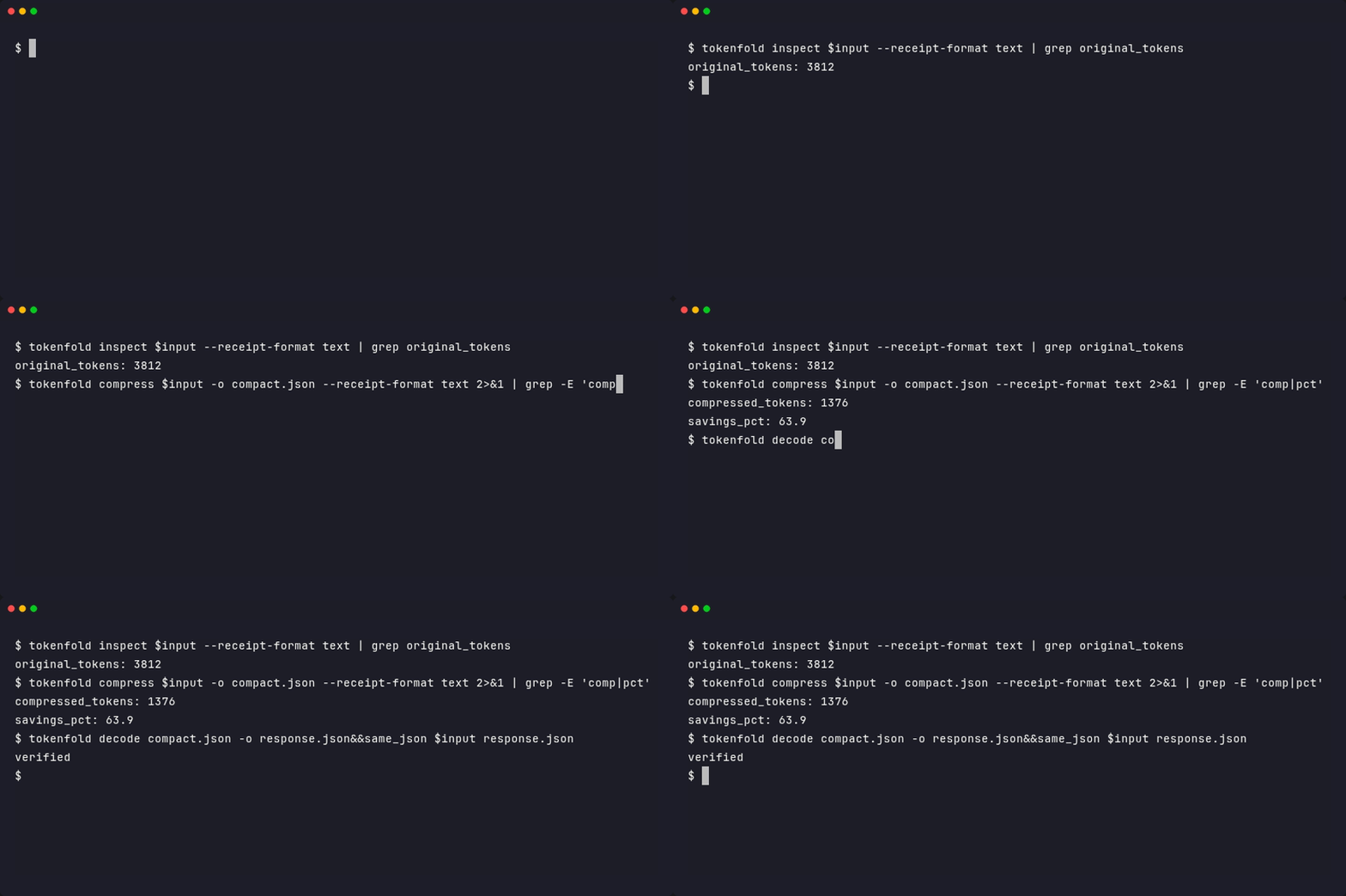
How this demo was generated (VHS tape)
The VHS tape runs inspect, compress, and
decode against the bundled API response, including the 63.9% receipt.
Run vhs docs/tokenfold-demo.tape to regenerate the GIF; the tape requires
tokenfold on PATH.
| Workload | Type | Core mode | Savings |
|---|---|---|---|
| API responses | 30-record JSON payload | Lossless | 63.9% fewer tokens |
| Tool schemas | OpenAI tool-schema fixture (Criterion bench) | Lossless | 45.6% fewer tokens |
| Repetitive JSON | 50-record payload | Lossless | 67.6% fewer tokens |
These figures use exact o200k_base counts in the balanced preset. Versioned
inputs and provenance live in tests/fixtures/readme_metrics.json.
Recoverable pruning is separate, opt-in extended tooling.
Start the local proxy once, then point an existing client at it. The proxy forwards provider-shaped requests to your fixed upstream and applies Core's lossless transforms before forwarding.
cargo install tokenfold-proxy
tokenfold-proxy --upstream https://api.openai.com
The proxy installs from source via Cargo and listens on 127.0.0.1:8787 by
default (--bind; use --allow-non-loopback-bind to change that). Only
chat-shaped JSON bodies (a non-empty messages array) are compressed on the
passthrough path; anything else forwards untouched. Non-GET /livez|/readyz|/health
requests forward upstream with the incoming path appended to --upstream, so
point OpenAI-shaped clients at <bind>/v1. Prebuilt, checksummed release
binaries are published for the CLI only; the proxy has no prebuilt binary.
SSE responses stream through unbuffered with a whole-exchange
--upstream-timeout-secs deadline.
from openai import OpenAI

# Your client's Authorization header is forwarded to upstream unchanged -
# no credential reconfiguration needed.
client = OpenAI(base_url="http://127.0.0.1:8787/v1")
# Existing calls work unchanged: client.chat.completions.create(...)
Works out-of-the-box with any client or framework that accepts a custom base URL (LangChain, LlamaIndex, LiteLLM, Instructor, or direct HTTP clients).
| Interface | 1-line install / command | Primary use case |
|---|---|---|
| Proxy | cargo install tokenfold-proxy |
Existing OpenAI-compatible clients |
| CLI | cargo install tokenfold-cli |
Files, stdin, and shell workflows |
| Python | pip install tokenfold |
Application pipelines |
| TypeScript | npm install tokenfold |
Node.js applications and automation |
| Rust | cargo add tokenfold-core |
Native embedding |
| MCP | tokenfold mcp serve |
Agents and editors |
For files and stdin, install the CLI with cargo install tokenfold-cli or use a
checksummed GitHub Release, then:
tokenfold inspect payload.json --format json
tokenfold compress payload.json --format json --output payload.compact.json
For direct Python calls, use the same Core engine and typed receipt:
from tokenfold import InputFormat, compress

# Accepts raw JSON bytes or str (messages, tools, or schemas)
request_json_bytes = b'{"messages": [{"role": "user", "content": "hello"}]}'
result = compress(request_json_bytes, format=InputFormat.OPENAI_JSON)

# For standalone JSON records, use: format=InputFormat.JSON
compressed_payload = result.payload  # bytes
print(f"Saved {result.report.saved_tokens} tokens ({result.saved_pct():.1f}%)")| Preset | Behavior |
|---|---|
conservative |
Minification only; no restructuring of what the model sees. |
balanced (default) |
Minification plus reversible columnar folding (json_field_fold, json_value_dict, log_field_fold) on eligible formats. |
aggressive |
Same default transform set as balanced today. |
Provider message formats (openai_json, anthropic_json) never receive
columnar folding: only minification applies, so API shapes stay intact.
Runnable examples, one per surface, all under examples/:
python examples/quickstart.py      # Python: compress messages, request bodies, JSON data
node examples/quickstart.mjs       # TypeScript/Node: compress, inspect, read the receipt
cargo run -p tokenfold-core --example quickstart   # Rust: the embedded core API
python examples/lossy_pruning.py   # CLI: opt-in recoverable pruning, end to end
examples/quickstart.ipynb is the guided tour of the whole
Python surface: everything quickstart.py shows, plus previews, budgets and presets,
provider payloads, recoverable pruning with retrieval, and where Tokenfold Select fits.
Coding agents can exhaust context limits on large shell outputs. Tokenfold runs as a
stdio MCP server exposing tokenfold_compress, tokenfold_inspect,
tokenfold_retrieve, and tokenfold_stats, with pre-configured filters for Git
status, diffs, build output, and test logs before they consume agent context.
tokenfold init currently supports Claude Code; Codex uses manual MCP
registration:
tokenfold init --agent claude-code
tokenfold doctor --agent claude-code

# Or connect manually in Codex:
codex mcp add tokenfold -- tokenfold mcp serve
tokenfold init --agent claude-code merges a project-scoped .mcp.json entry without replacing
other servers; tokenfold doctor --agent claude-code verifies it. tokenfold_inspect
is side-effect-free (never returns a modified payload); tokenfold_retrieve
retrieves by hash or marker (report references are reserved but not yet
resolvable). See
docs/configuration.md for tested MCP JSON/TOML and every environment
override. Trusted filters for Git, build, and test output
are available through tokenfold filters list.
Semantic prompt compressors such as LLMLingua use a smaller language model to identify and remove less-important prompt tokens. Tokenfold solves a different problem first: repeated keys, values, schemas, rows, and other structural redundancy. Core needs no model, is deterministic, and verifies an exact decode before accepting a lossless transform. Tokenfold does not inject prompt guidance or fine-tune models. Exact decode proves data recovery, not unchanged downstream task accuracy; validate folded payloads with your representative workload.
Tokenfold Select is Tokenfold's complementary query-aware offering: when structure ends, it ranks what matters under a token budget.
When structure ends, rank what matters.
Tokenfold Select is an Apache-2.0 LoRA adapter on
ibm-granite/granite-embedding-reranker-english-r2. It scores candidate spans
against a query; your allocator applies the token budget and force-keeps
required content. It is a separately distributed offering. Core remains
model-free and deterministic and neither loads nor invokes Select.
| Tokenfold Core | Tokenfold Select | |
|---|---|---|
| Best at | Structural compression | Query-conditioned span ranking |
| Runtime | Static Rust binary | Granite reranker + LoRA adapter |
| Output | Compressed payload + exact receipt | Ranking logits |
Python: load the model and score spans
from pathlib import Path

import torch
from huggingface_hub import snapshot_download
from peft import PeftModel
from transformers import AutoModelForSequenceClassification, AutoTokenizer

base_id = "ibm-granite/granite-embedding-reranker-english-r2"
repo_dir = Path(snapshot_download("snchimata/tokenfold-select"))
adapter_dir = repo_dir / "adapter"
tokenizer = AutoTokenizer.from_pretrained(adapter_dir)
base = AutoModelForSequenceClassification.from_pretrained(
    base_id,
    dtype=torch.float32,
)
model = PeftModel.from_pretrained(base, adapter_dir).eval()

def score(query: str, spans: list[str]) -> list[float]:
    if not spans:
        return []
    encoded = tokenizer(
        [query] * len(spans),
        spans,
        padding=True,
        truncation=True,
        max_length=8192,
        return_tensors="pt",
    )
    with torch.no_grad():
        output = model(
            input_ids=encoded["input_ids"],
            attention_mask=encoded["attention_mask"],
        )
    return output.logits.view(-1).float().tolist()
Tokenfold Select is Tokenfold's query-aware model for choosing what fills a tight context window after structural compression ends. It is distributed and evaluated separately; Tokenfold Core does not invoke it. Headroom's generic JSON engine is evaluated above; this table evaluates Kompress-v2, Headroom Labs' query-aware selection baseline. These figures are source-reported external results, not Core CI results.
| Tokens kept | Tokenfold Select | Kompress-v2 (Headroom) native | Kompress-v2 (Headroom) relevance | BM25 | vs. best baseline |
|---|---|---|---|---|---|
| 50% | 86.3% | 66.5% | 80.5% | 79.4% | +5.8 pp |
| 25% | 70.3% | 47.2% | 61.5% | 60.7% | +8.8 pp |
| 10% | 39.9% | 30.4% | 37.7% | 37.7% | +2.2 pp |
Tokenfold Select beat every measured baseline at every budget. At a 25% budget, the fine-tuned ranker keeps the answer 70.3% of the time: an 8.8 percentage point lead over the strongest baseline (Kompress-v2 relevance, 61.5%), and a 15.8% relative lift over BM25 (60.7% -> 70.3%). Critical-content survival is 100% at every measured budget through allocator force-keep. Results are three-seed repeated subsampling over roughly 73,000 training and 24,000 held-out fixtures per run; the model card publishes the training recipe and full baseline set. Here, task success means the literal gold answer survived selection under the stated budget. These are source-reported external results, pinned by model revision in the metric manifest; Core CI does not reproduce them.
See the Tokenfold Select model card for setup, evaluation, training data, and limitations.
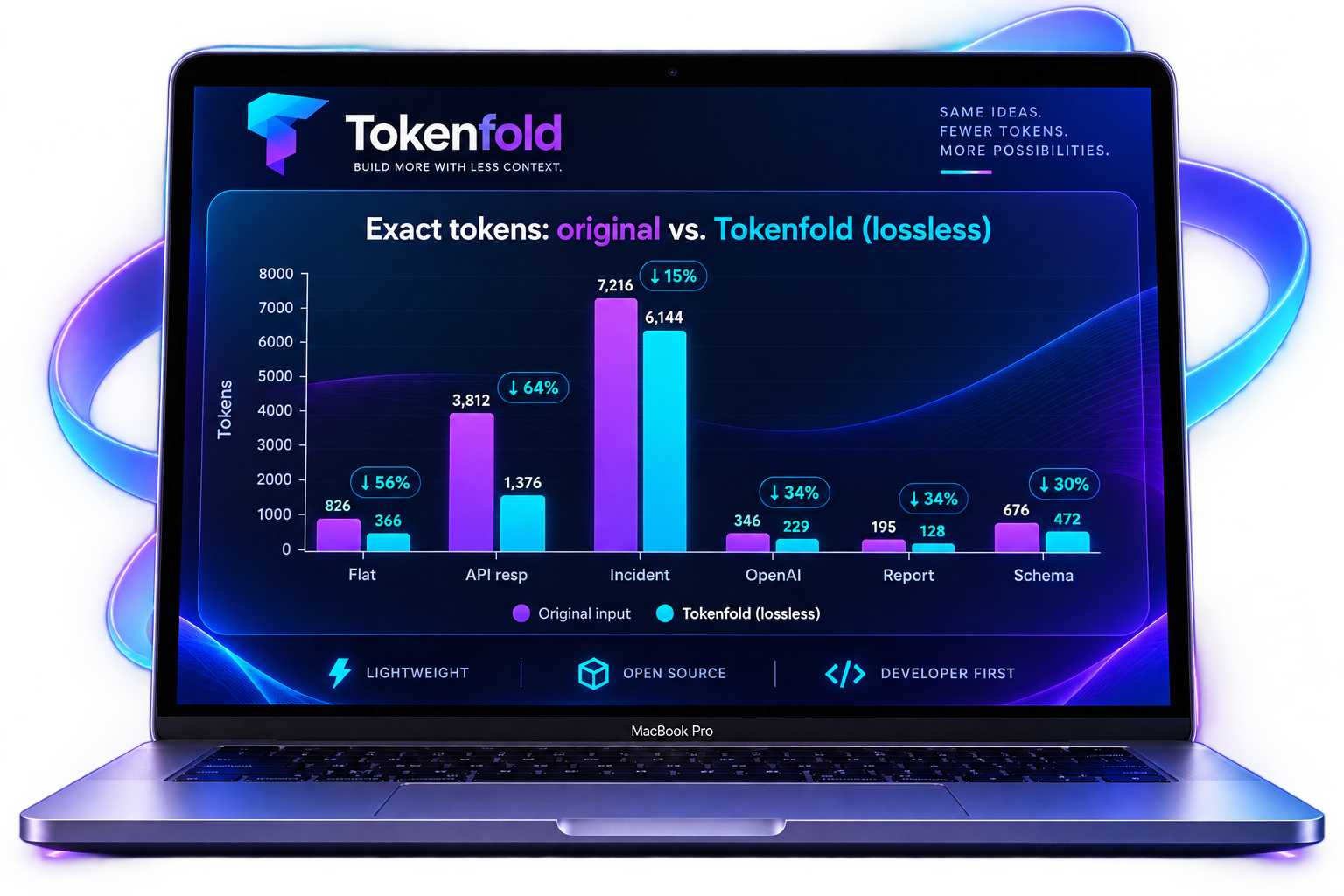
Exact o200k_base token counts, original input versus Tokenfold's lossless
output across the six-fixture Headroom corpus:
| Workload | Original | Tokenfold | Headroom | Token winner; recovery |
|---|---|---|---|---|
| Flat uniform records | 826 | 366 | 826 | Tokenfold (-55.7%); both exact |
| Nested API response | 3,812 | 1,376 | 3,812 | Tokenfold (-63.9%); both exact |
| Semi-uniform incident feed | 7,216 | 6,144 | 6,963 | Tokenfold (-14.9%); Headroom altered payload |
| Deeply nested OpenAI payload | 346 | 229 | 335 | Tokenfold (-33.8%); Headroom altered payload |
| Nested compression report | 195 | 128 | 195 | Tokenfold (-34.4%); both exact |
| Deeply nested report schema | 676 | 472 | 676 | Tokenfold (-30.2%); both exact |
| Six-fixture corpus | 13,071 | 8,715 (33.3% saved) | 12,807 (2.0%) | Tokenfold won 6/6; exact recovery 6/6 |
See the Headroom methodology for environment setup, pinned comparator revision, and reproduction.
| Workload | Compact JSON | Tokenfold JSON | TOON 4.1.1 | Token winner; round trip |
|---|---|---|---|---|
| Flat uniform records | 586 | 366 | 377 | Tokenfold (-37.5%); both round trip |
| Nested API response | 2,366 | 1,376 | 2,839 | Tokenfold (-41.8%); both round trip |
| Semi-uniform incident feed | 6,144 | 6,144 | 6,579 | Tokenfold retains compact JSON; both round trip |
| Deeply nested OpenAI payload | 229 | 229 | 237 | Tokenfold retains compact JSON; both round trip |
| Nested compression report | 128 | 128 | 131 | Tokenfold retains compact JSON; both round trip |
| Deeply nested report schema | 472 | 472 | 517 | Tokenfold retains compact JSON; both round trip |
| Wide metrics table | 6,310 | 4,061 | 4,161 | Tokenfold (-35.6%); both round trip |
| Seven-fixture corpus | 16,235 | 12,776 | 14,841 | Tokenfold fewer on 7/7 (3 transforms, 4 never-larger guards); 13.9% fewer than TOON |
In aggregate across the seven fixtures:
| Encoding across seven JSON fixtures | Exact tokens | vs. compact JSON |
|---|---|---|
| Tokenfold JSON | 12,776 | 21.3% fewer |
| Compact JSON | 16,235 | baseline |
| Official TOON CLI 4.1.1 | 14,841 | 8.6% fewer |
On irregular structures, TOON can use more tokens than compact JSON. Tokenfold's never-larger guard retains compact JSON when an eligible lossless transform would not reduce the exact token count.
All counts use exact o200k_base recounts. Tokenfold passed exact recovery on
all six Headroom fixtures and all seven TOON fixtures; Headroom's emitted JSON
matched the input value on 4/6 fixtures (the semi-uniform incident feed and the
deeply nested OpenAI payload differed), so its aggregate reduction is not a
lossless result. See the Headroom methodology
and TOON methodology for the versioned corpora, pinned
comparator revisions, and full fixture-level results.
Headroom benchmark methodology and reproduction
This comparison covers default local generic-JSON paths, not multi-turn message history or hosted proxy behavior. On these raw JSON arrays, schemas, and nested payloads, Tokenfold's default local path produced fewer tokens than Headroom on all six while decoding every value exactly.
Both outputs were recounted with exact o200k_base. Tokenfold passed exact
decode checks on 6/6 fixtures; Headroom's emitted JSON matched the input value
on 4/6, so its aggregate reduction is not a lossless result. This comparison
uses each project's default local generic-JSON API, not hosted proxy behavior,
with Headroom pinned to 4c9c29c.
See the checked-in report,
corpus, and
reproduction command.
TOON benchmark methodology and reproduction
Tokenfold now supports TOON as an explicit, round-trip-verified output codec. Its default structural JSON encoding is still the better choice when the goal is the fewest tokens.
The new examples/toon_metrics.json fixture is a 120-row, wide, uniform
metrics table - the shape where TOON is expected to be strongest. Tokenfold
produced fewer tokens than TOON on all seven fixtures and used 13.9% fewer
tokens in aggregate: a reducing structural transform on three fixtures, and
the never-larger guard retaining compact JSON (still smaller than the TOON
output) on four. Both paths passed lossless recovery checks.
The benchmark uses exact o200k_base counts and the same versioned corpus for
both tools. See the checked-in TOON report
and reproduction command.
These additional capabilities extend Core with recoverable pruning and an explicit TOON output codec.
| Capability | What you get |
|---|---|
| Recoverable pruning | Drop low-signal JSON rows only after storing them locally; fetch any omission with tokenfold retrieve |
| JSON or TOON output | Keep Tokenfold's compact JSON default or explicitly emit verified TOON for compatible consumers |
While Tokenfold Core defaults to lossless structural folding, heterogeneous array feeds (such as long logs or search results) benefit from recoverable pruning when strict context budgets apply:
| Lossless - default | Recoverable lossy - opt-in | |
|---|---|---|
| What it does | Minifies, folds repeated keys into columns, and stores repeated values once | Adds deterministic ranking and retrieval markers for selected array rows |
| Best on | Uniform records, schemas, logs, diffs | Search results, mixed event feeds, agent traces, long arrays |
| Measured here | 45.6-67.6% fewer tokens on three bundled fixtures | 51.7-96.3% fewer tokens (40-event feed at 51.7-68.2%; 100-row showcase at 96.3%) |
| Recovery | All data remains in the payload | Every emitted marker resolves through the local retrieval store |
Lossless folding has a ceiling on heterogeneous arrays. --prune ranks rows,
keeps the strongest signals, and replaces selected rows with compact
{"$tf_ref": {...}} handles. A row leaves the payload only after the local
store accepts it.
tokenfold compress examples/incident_feed.json --format json \
  --prune --keep-ratio 0.35 --output feed.compact.json
On the bundled 40-event feed:
| Mode | Exact tokens | Reduction | Events kept | Incident kept |
|---|---|---|---|---|
| Lossless | 6,144 | 14.9% | 40 | Yes |
--keep-ratio 0.35 |
3,485 | 51.7% | 13 | Yes |
--keep-ratio 0.05 |
2,294 | 68.2% | 1 | Yes |
The planted 503 with success: false and retries: 7 survives every shown
setting because typed failure signals outrank position and length - at
--keep-ratio 0.05 it is the only row kept. Long rows
amortize marker overhead further: the 100-result showcase reaches 96.3% fewer tokens
(--keep-ratio 0.02, examples/max_showcase.json; see
tests/fixtures/readme_metrics.json).
Fetch a dropped row using the same --retrieval-store and
--retrieval-namespace as the compression run:
tokenfold compress examples/incident_feed.json --format json \
  --prune --keep-ratio 0.35 --output feed.compact.json \
  --retrieval-store ./store --retrieval-namespace incident-demo
tokenfold retrieve cb13cc59cca0c218c579cd1d4b3cbab58d6dea265eb995cc9c00faf0cd0a6856 \
  --retrieval-store ./store --retrieval-namespace incident-demo
# {"seq":1,"ts":"2026-08-15T00:01:11Z","subsystem":"index-writer",...}
What the flags mean:
--keep-ratiois an aggression hint over eligible array items. Lower keeps fewer rows; it is not a whole-document guarantee.--target-tokensis the whole-document goal. Tokenfold stops when it reaches the target losslessly and reportsbest_effortwhen the safe transform set cannot reach it (unreachablewhen protected content alone exceeds the target).--preserve <path>protects a named array; nested paths conservatively protect their nearest eligible ancestor.- Generic JSON only: lossy pruning does not run on OpenAI or Anthropic message
payloads. Pass the same
--retrieval-store/--retrieval-namespacetotokenfold retrievethat the compress run used. - Storage is fail-closed: refused rows stay inline, and detected secret-shaped
bytes are never persisted. Lossy pruning requires the
filesystemretrieval backend with TTL >= 24h (memory backends and near-immediate expiry are rejected);$tf_refis reserved.
Preview the projected savings with no store writes:
tokenfold inspect examples/incident_feed.json --format json \
  --prune --keep-ratio 0.35
The same flags, and the same fail-closed contract, from Python and TypeScript. Use a throwaway store directory while experimenting and reuse it for retrieval:
import json
from pathlib import Path
from tokenfold import InputFormat, PruningPolicy, compress, retrieve

store = Path(".tokenfold-readme-store")
feed_bytes = Path("examples/incident_feed.json").read_bytes()
pruning = PruningPolicy(
    keep_ratio=0.35,
    retrieval_store=store,
    retrieval_namespace="readme-demo",
)
result = compress(feed_bytes, format=InputFormat.JSON, pruning=pruning)
payload = json.loads(result.payload)
marker = next(e["$tf_ref"] for e in payload["events"] if "$tf_ref" in e)
original = retrieve(
    marker, retrieval_store=store, namespace="readme-demo"
)  # any dropped row, verbatim
Current Phase 1 constraints
Treat $tf_ref as reserved and do not enable lossy pruning on documents that
already contain retrieval markers. Filesystem entries are published under a
cross-process lock, and a refused batch leaves every candidate inline.
Preview is a projection rather than a filesystem transaction, so a real run may keep more rows if storage becomes unavailable.
Compact Tokenfold JSON remains the default. For a TOON-aware consumer, request TOON explicitly and decode it through the same verified codec:
tokenfold compress examples/toon_metrics.json --format json \
  --preset conservative --encoding toon --output payload.toon
tokenfold decode payload.toon --from toon --output payload.json
TOON is available only for generic JSON and never activates implicitly. The receipt reports the exact encoding delta and warns when TOON is larger than the already-compressed JSON representation.
- Never larger: Core keeps a transform only when exact recounting shows a reduction; a lossy branch must also beat the lossless result.
- Reversible structure: JSON folds must pass an exact round trip.
- Protected content: provider system messages and latest-user content are held behind format-aware safety gates.
- Clear provenance: exact tokenizer counts, heuristics, and extrapolations are labeled separately.
- Actionable receipts: every result lists savings, transforms, warnings, retrieval state, and final status.
- Local control: detected secrets are redacted before reports or storage;
policy learning changes configuration only with
--apply.
The offline fidelity gate uses deterministic lexical-overlap, critical-token,
and containment proxies. Those checks catch regressions but do not establish
semantic equivalence or downstream task success. Runtime quality fields are
absent unless a versioned evaluator has supplied data; applications should run
their own representative task evaluation before enabling lossy pruning.
# 96.3% maximum-compression showcase, mixed-feed curve, retrieval, and preserve
python examples/lossy_pruning.py

# Lossless transform benchmarks
cargo bench -p tokenfold-core

# Head-to-head provider benchmark (setup and pinned dependency command)
# See eval/research/README.md

# Small exact-token CLI example
cargo run --release --locked -p tokenfold-cli -- \
  inspect examples/api_response.json --format json
The bundled 30-record API response reports 3,812 -> 1,376 tokens, a 63.9%
lossless reduction. Benchmark sources and thresholds live in CHANGELOG.md
and crates/tokenfold-core/benches/THRESHOLDS.toml.
Issues and pull requests are welcome. Run the relevant checks before opening a PR:
cargo fmt --all --check
cargo clippy --workspace --all-targets -- -D warnings
cargo test --workspace --locked
python eval/run_fidelity.py --gate --profile smoke-first-consumer
python eval/test_baseline_fixture_contract.py
python eval/audit_quality_sample.py --check
cd packages/tokenfold && npm ci && npm testStart with one representative payload, inspect the receipt, and see how many tokens your application can stop sending today.
If Tokenfold earns a place in your stack, a star on GitHub helps the next team find it.

