

Small · Sortable · Secure ID generator




pikaid is the official Python implementation of a compact, chronologically sortable, collision-resistant identifier format for databases, APIs, and distributed systems.
This is the immutable, unversioned pikaid format, documented in specification revision 1.0.4.
- Short: Compact, readable IDs for URLs, logs, and API resources.
- Sortable: Lexicographically ordered by timestamp, with one-second precision.
- Collision-resistant: 96 bits of cryptographic randomness make collisions extremely unlikely, never impossible.
- Storage-friendly: Use
BINARY(17)or readableCHAR(26). - Distributed-friendly: No central sequence generator or coordination required.
A pikaid contains 26 lowercase Base36 characters: a 7-character Unix-seconds timestamp followed by 19 characters encoding 96 bits of cryptographic randomness. Its binary form is 17 bytes: 5 unsigned big-endian timestamp bytes followed by 12 randomness bytes.
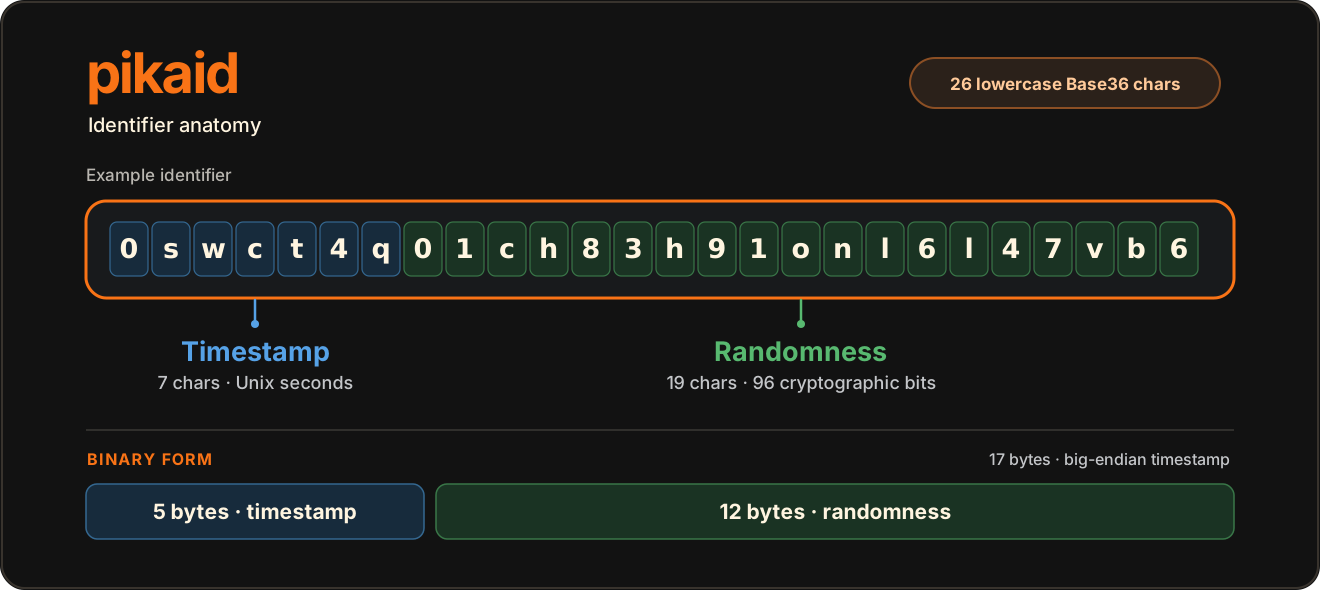
Ordering: Different seconds sort chronologically. Within the same second, randomness—not issuance order—decides the order.
Security: These are identifiers, not secrets, session credentials, authentication tokens, or API keys.
- Python 3.11 or newer.
- No runtime dependencies; randomness comes from the operating system CSPRNG
through :func:
secrets.token_bytes.
Python 3.11 is the oldest version with the typing and standard-library features this package targets, and it is still receiving security fixes. CI verifies supported CPython versions on Linux, macOS, and Windows; PyPy and free-threaded builds are not claimed.
The package is not yet published to PyPI. Install it from this public source repository:
git clone https://github.com/pikaid/pikaid-python.git
cd pikaid-python
python -m pip install .
For development and tests, use python -m pip install -e '.[dev]' from the checkout.
Copy and run the complete example below (for example, save it as demo.py and execute python demo.py):
from pikaid import generate, parse, to_binary, from_binary, is_valid

identifier = generate()
assert is_valid(identifier)
parsed = parse(identifier)
binary = to_binary(identifier)
assert len(identifier) == 26 and len(binary) == 17
assert from_binary(binary) == identifier
print(identifier, parsed.timestamp)Use pikaid to identify users, orders, invoices, uploads, events, and API resources. Independent services can generate compact IDs without a shared counter, while timestamp-based ordering helps with indexing, sorting, and logs.
The normative specification revision 1.0.4 is pinned at commit 17014d76f568c3ac9f9ce2927c1a018fdbc36d1d. The independent PHP v1.2.0 interoperability fixtures originate from commit e3f843edeb5157a5d2d25196cac0d69580810a95.
Specification revisions describe the format; they do not change the encoded identifiers.
The module-level functions and the Pikaid value type are equivalent entry
points; use whichever reads better in context. Pikaid is an immutable,
hashable, orderable dataclass.
| Name | Kind | Description |
|---|---|---|
generate(timestamp=None) |
function | New identifier as 26-character str; defaults to the current second. |
generate_binary(timestamp=None) |
function | New identifier as 17 bytes. |
Pikaid.generate(timestamp=None) |
class method | New validated Pikaid. |
parse(value) / Pikaid.parse(value) |
function / class method | Strictly decode a string; raise InvalidPikaidError. |
from_binary(value) / Pikaid.from_binary(value) |
function / class method | Strictly decode 17 bytes; accept bytes, bytearray, or memoryview. |
to_binary(value) |
function | Convert a string or Pikaid to 17 bytes. |
is_valid(value) |
function | Full semantic validity as bool; never raises. |
is_well_formed(value) |
function | Length-and-alphabet shape check as bool; never raises. |
Pikaid.timestamp |
attribute | Unsigned whole Unix seconds, 0..78_364_164_095. |
Pikaid.randomness |
attribute | Exactly 12 raw entropy bytes. |
Pikaid.randomness_hex |
property | The entropy as 24 lowercase hex characters. |
Pikaid.datetime |
property | Timezone-aware UTC datetime for the timestamp. |
Pikaid.to_string() / str(value) |
method | Canonical 26-character form. |
Pikaid.to_binary() |
method | Canonical 17-byte form. |
Public constants: ALPHABET, STRING_LENGTH, TIMESTAMP_CHARS,
RANDOMNESS_CHARS, BINARY_LENGTH, TIMESTAMP_BYTES, RANDOMNESS_BYTES,
MAX_TIMESTAMP, and MAX_RANDOMNESS.
Errors: PikaidError is the common base. InvalidPikaidError and
InvalidTimestampError also subclass ValueError; EntropySourceError also
subclasses RuntimeError.
Generate an identifier for the current second:
>>> from pikaid import generate, parse
>>> identifier = generate()
>>> len(identifier)
26
>>> identifier == identifier.lower()
True
>>> isinstance(parse(identifier).timestamp, int)
True
Generate with an explicit timestamp, or obtain the binary form directly:
>>> from pikaid import generate_binary
>>> parsed = parse(generate(timestamp=1700000000))
>>> parsed.timestamp
1700000000
>>> len(generate_binary(timestamp=1700000000))
17
Encode, decode, and convert without loss using a deterministic value:
>>> from pikaid import Pikaid, from_binary, to_binary
>>> known = Pikaid(timestamp=1700000000, randomness=bytes.fromhex("00112233445566778899aabb"))
>>> str(known)
'0s44we8002loz3po6mcf6vsn23'
>>> known.to_binary().hex()
'006553f10000112233445566778899aabb'
>>> known.randomness_hex
'00112233445566778899aabb'
>>> parse(str(known)) == known
True
>>> from_binary(known.to_binary()) == known
True
>>> to_binary(str(known)) == known.to_binary()
True
Validate strictly before trusting input:
>>> from pikaid import is_valid, is_well_formed
>>> is_valid("00000000000000000000000000")
True
>>> is_valid("0000000000000000000000000")
False
>>> is_well_formed("0000000" + "z" * 19)
True
>>> is_valid("0000000" + "z" * 19)
False
is_well_formed checks only the length and alphabet. is_valid performs full
semantic validation, including the 96-bit randomness limit. Both are distinct
from parsing: parse raises an exception instead of returning a boolean.
Invalid input raises a subclass of PikaidError:
>>> from pikaid import InvalidPikaidError, InvalidTimestampError
>>> try:
...     parse("NOT A PIKAID")
... except InvalidPikaidError:
...     print("rejected")
rejected
>>> try:
...     generate(timestamp=-1)
... except InvalidTimestampError:
...     print("rejected")
rejected
Comparison and sorting follow the timestamp and then the randomness bytes:
>>> early = Pikaid(timestamp=1, randomness=bytes(12))
>>> late = Pikaid(timestamp=2, randomness=bytes(12))
>>> early < late
True
>>> str(early) < str(late)
True
>>> early.to_binary() < late.to_binary()
True
- Sortable across seconds, not within one. Lexicographic string order and
unsigned bytewise binary order agree with
Pikaidordering. Identifiers generated in the same second are ordered by randomness, which is not monotonic and not related to creation time. - Randomness, not uniqueness. 96 bits of CSPRNG output make collisions negligible in practice, but uniqueness is not guaranteed and must not be assumed for correctness-critical decisions.
- Not a secret or an authentication token. The timestamp is visible, and a pikaid carries no signature, MAC, or confidentiality. Do not use it as a bearer credential or as proof of origin.
- Whole seconds only. There is no sub-second precision and no monotonic counter. Do not use pikaid ordering as a substitute for a sequence.
- Fail closed. If the CSPRNG raises or returns the wrong amount of data,
generation raises
EntropySourceError; no identifier is produced. - Strict decoding. Uppercase, whitespace, non-ASCII, wrong lengths,
timestamps outside
0..78_364_164_095, and randomness above2**96 - 1are rejected. Input is never trimmed, padded, or case-folded. - Timestamps are caller-controlled.
generate(timestamp=...)trusts the supplied value within range; it does not verify that it is the real current time.
MAX_TIMESTAMP is 36**7 - 1, which corresponds to
4453-04-05 15:21:35 UTC. The datetime property is computed arithmetically
from the Unix epoch so it does not depend on platform fromtimestamp limits.
| Representation | Size | Recommended for |
|---|---|---|
| BINARY(17) | 17 bytes | Compact primary keys and indexes |
| CHAR(26) | 26 characters | Readable SQL, debugging, URLs, and logs |
Use an ASCII bytewise/binary collation for text columns (for example, ascii_bin on MariaDB/MySQL). Case-insensitive or locale-aware sorting is not a substitute for canonical bytewise comparison.
The CI workflow runs native tests, pinned automated conformance checks, and language-specific quality gates. To run the native checks locally from a checkout, use python -m pytest after installing the development extras.
Automated passing tests are not a security certification. The independent CSPRNG source and failure-path audits (P-GENERATE-RNG-SOURCE and P-GENERATE-RNG-FAILURE) still require separate human evidence.
Platform, tooling, and conformance details
uv venv --python 3.12
uv sync --extra dev
uv run ruff format --check .
uv run ruff check .
uv run mypy src
uv run pytest --cov=pikaid --cov-report=term-missing
The test suite runs every official vector, checks the fixture checksums and
schema, and adds a pinned cross-representation conformance matrix: independent
known-answer, malformed-input, overflow, boundary, zero-padding, property-based
round-trip, ordering, generated-value, and CSPRNG-failure tests.
tests/test_readme.py executes the README examples, and the test command
enforces 100% line and branch coverage; the CI workflow applies the same gate
to every matrix entry when hosted runners are available.
tests/official/ contains a test-only JSON-Lines adapter and a fail-closed
driver for the official cross-language suite, pinned to the immutable
pikaid-specs commit 059780cc0e5b113443812720d95c630649bf3aa3 (suite 1.0.0,
specification 1.0.4). See tests/official/README.md.
The suite's --automated-only exit 0 means the automated checks passed. It is
not a conformance certification: P-GENERATE-RNG-SOURCE and
P-GENERATE-RNG-FAILURE remain manual human-audit items, and the suite's
default exit 3 means that audit is still outstanding.
Registry publication is not implied by a green CI: use the installation method documented above.
Contributions are always welcome! 💙
Whether you're fixing a typo, improving documentation, adding tests, or making pikaid even better, every contribution is appreciated.
Want to help? Here's how:
- 🐛 Found a bug? Open an issue with clear reproduction steps.
- 💡 Have an idea? Start with an issue before making major changes.
- 🛠️ Ready to contribute? Open a pull request explaining your changes.
- 🧪 Keep it tested. Add meaningful regression tests for behavior changes and follow the existing conventions.
- ✅ Make sure CI passes. All required checks must be green before a pull request is merged. No shortcuts!
One important rule: pikaid's identifier format is immutable. Contributions must preserve the canonical specification (revision 1.0.4).
🔐 Found a security vulnerability? Report it privately using GitHub's security reporting (when available), or contact the maintainer—not through a public issue.
Every improvement matters, big or small. Thanks for helping make pikaid better! 🐇
The implementation is available under the MIT License.
For licensing or project-related questions: larananas.dev@proton.me.