

Small · Sortable · Secure ID generator




pikaid is the official Java implementation of a compact, chronologically sortable, collision-resistant identifier format for databases, APIs, and distributed systems.
This is the immutable, unversioned pikaid format, documented in specification revision 1.0.4.
- Short: Compact, readable IDs for URLs, logs, and API resources.
- Sortable: Lexicographically ordered by timestamp, with one-second precision.
- Collision-resistant: 96 bits of cryptographic randomness make collisions extremely unlikely, never impossible.
- Storage-friendly: Use
BINARY(17)or readableCHAR(26). - Distributed-friendly: No central sequence generator or coordination required.
A pikaid contains 26 lowercase Base36 characters: a 7-character Unix-seconds timestamp followed by 19 characters encoding 96 bits of cryptographic randomness. Its binary form is 17 bytes: 5 unsigned big-endian timestamp bytes followed by 12 randomness bytes.
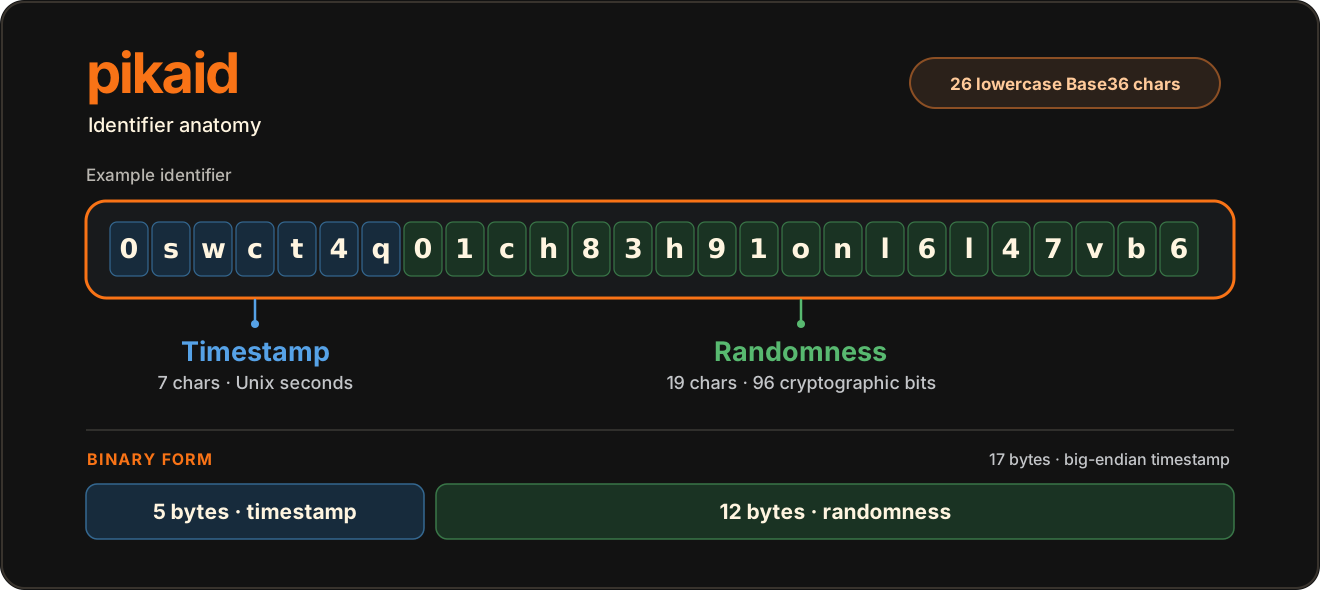
Ordering: Different seconds sort chronologically. Within the same second, randomness—not issuance order—decides the order.
Security: These are identifiers, not secrets, session credentials, authentication tokens, or API keys.
- Java 17 or newer. The library is compiled with
--release 17and has no runtime dependencies outside the JDK. - Maven 3.9 or newer when building from source. The included Maven Wrapper
(
./mvnw) downloads a compatible Maven version.
From this public source repository, compile the library before using it locally:
git clone https://github.com/pikaid/pikaid-java.git
cd pikaid-java
./mvnw -q -DskipTests package<dependency>
<groupId>dev.pikaid</groupId>
<artifactId>pikaid</artifactId>
<version>1.0.0</version>
</dependency>implementation("dev.pikaid:pikaid:1.0.0")To install the built artifact into your local Maven repository:
./mvnw installSave this complete example as Main.java in the repository root and run javac -cp target/classes Main.java && java -cp target/classes:. Main:
import dev.pikaid.Pikaid;

public class Main {
    public static void main(String[] args) {
        Pikaid id = Pikaid.generate();

        String text = id.toString();            // 26 lowercase Base36 characters
        byte[] binary = id.toBinary();          // exactly 17 bytes
        long timestamp = id.timestamp();        // unsigned Unix seconds
        String randomness = id.randomnessHex(); // 24 lowercase hexadecimal characters

        Pikaid fromText = Pikaid.parse(text);
        Pikaid fromBinary = Pikaid.fromBinary(binary);

        assert fromText.equals(id);
        assert fromBinary.equals(id);
        System.out.println(text);
    }
}Use pikaid to identify users, orders, invoices, uploads, events, and API resources. Independent services can generate compact IDs without a shared counter, while timestamp-based ordering helps with indexing, sorting, and logs.
Specification revisions describe the format; they do not change the encoded identifiers.
| Method | Purpose |
|---|---|
Pikaid.generate() |
Generate with the current UTC second and a CSPRNG. |
Pikaid.generate(long timestamp) |
Generate with an explicit timestamp and a CSPRNG. |
Pikaid.generateBinary() |
Generate and return the 17-byte binary form. |
Pikaid.of(long timestamp, byte[] randomness) |
Deterministic factory for fixtures and raw-field pipelines. |
Pikaid.parse(String value) |
Strictly parse 26-character text. |
Pikaid.fromBinary(byte[] value) |
Strictly decode exactly 17 bytes. |
Pikaid.isValid(String value) |
Full semantic validation, returning false on failure. |
Pikaid.isWellFormed(String value) |
Shape-only length/alphabet check. |
timestamp() / timestampInstant() |
Timestamp as unsigned seconds or a UTC Instant. |
randomness() / randomnessHex() |
Defensive copy of the twelve bytes or lowercase hex. |
toBinary() |
New 17-byte binary representation. |
toString() |
Canonical 26-character text. |
compareTo(Pikaid other) |
Timestamp, then unsigned suffix order. |
All public types and members are documented in the generated Javadoc.
import dev.pikaid.Pikaid;
import java.util.HexFormat;

// Randomness still comes from the CSPRNG.
Pikaid fixed = Pikaid.generate(1_700_000_000L);

// Deterministic factory for fixtures and interoperability pipelines.
// Normal production generation should use generate(...) or PikaidGenerator.
Pikaid known = Pikaid.of(
        1_700_000_000L,
        HexFormat.of().parseHex("00112233445566778899aabb"));

System.out.println(known); // 0s44we8002loz3po6mcf6vsn23if (Pikaid.isValid(candidate)) {
Pikaid id = Pikaid.parse(candidate);
// ...
}
Pikaid.parse(candidate); // throws PikaidFormatException if invalid
Pikaid.fromBinary(bytes); // throws PikaidFormatException if invalidPikaid.isWellFormed checks only the 26-character length and lowercase Base36
alphabet. It does not verify the 96-bit randomness limit, so its result must
not be described as full validity. Use Pikaid.isValid for semantic validation.
Strict parsing never normalizes, trims, case-folds, truncates, or silently
coerces input. Uppercase letters, non-ASCII characters, separators, wrong
lengths, randomness above 2^96 - 1, and binary timestamps above
78,364,164,095 are all rejected.
import dev.pikaid.Pikaid;
import dev.pikaid.PikaidGenerator;

PikaidGenerator generator = new PikaidGenerator(); // SecureRandom + system UTC clock
Pikaid id = generator.generate();
byte[] binary = generator.generateBinary();
PikaidGenerator also accepts a SecureRandom and a Clock for controlled
environments. Random-source failures propagate; generation fails closed and
never falls back to a weaker source.
- Ordering guarantee: for two identifiers with different timestamps, the earlier timestamp sorts first in both text and binary forms under ASCII-compatible lexicographic or unsigned bytewise comparison.
- No same-second monotonicity: identifiers created within the same second are ordered by their random suffix, not by generation order. pikaid is not a sequence generator and its timestamp has one-second precision.
- No uniqueness guarantee: 96 bits of randomness make collisions unlikely, but not impossible. Enforce uniqueness where required, for example with a database primary key or unique constraint.
- Not a secret: pikaid values are readable, are not authentication tokens, and do not replace authorization checks. No checksum is present, so a transcription error can still produce another valid identifier.
- Database storage: use
BINARY(17)or an equivalent fixed-width binary type, orCHAR(26)/VARCHAR(26)with a verified ASCII-compatible or binary collation. Default case-insensitive or punctuation-insensitive collations are not automatically safe for equality or ordering.
The approximate collision probability for n identifiers in one timestamp
bucket is 1 - exp(-n(n-1) / (2 * 2^96)); the 50% threshold is about
3.31 * 10^14 identifiers in the same second.
| Representation | Size | Recommended for |
|---|---|---|
| BINARY(17) | 17 bytes | Compact primary keys and indexes |
| CHAR(26) | 26 characters | Readable SQL, debugging, URLs, and logs |
Use an ASCII bytewise/binary collation for text columns (for example, ascii_bin on MariaDB/MySQL). Case-insensitive or locale-aware sorting is not a substitute for canonical bytewise comparison.
The CI workflow runs native tests, pinned automated conformance checks, and language-specific quality gates. To run the native checks locally from a checkout: ./mvnw verify.
Automated passing tests are not a security certification. The independent CSPRNG source and failure-path audits (P-GENERATE-RNG-SOURCE and P-GENERATE-RNG-FAILURE) still require separate human evidence.
Platform, tooling, and conformance details
The supported build runtimes are JDK 17 and JDK 21. The project targets Java 17 bytecode and is verified on both toolchains.
export JAVA_HOME=/path/to/jdk-17   # or jdk-21
./mvnw verify
The verify lifecycle compiles with -Xlint:all -Werror, runs the full JUnit 5
suite, enforces JaCoCo coverage thresholds, generates Javadoc, and builds the
library, sources, and Javadoc jars. The MIT license text is packaged as
META-INF/LICENSE in both the library and sources jars, so redistributors that
ship a bare jar carry the notice even without the repository checkout. Generated
files are reproducible for a given JDK and Maven toolchain:
project.build.outputTimestamp is pinned, so repeated clean builds of the same
commit with the same toolchain produce byte-identical artifacts. Different JDKs
may emit different but compatible bytecode and Javadoc HTML, so cross-toolchain
builds are verified for behavior and content rather than byte equality.
The local JUnit 5 suite runs on every platform in the CI matrix and includes:
- every vector in the vendored official PHP
v1.2.0fixture (4 valid, 6 invalid strings, 4 invalid binary values); - independent known-answer cases derived from the specification and a separate Base36 implementation;
- malformed, non-ASCII, uppercase, overflow, and boundary cases;
- zero-padding and maximum timestamp/randomness boundaries;
- seeded randomized round trips across text and binary, plus generated-ID sanity checks;
- cryptographic-source failure tests that prove generation fails closed;
- cross-representation ordering checks;
- README examples mirrored by executable tests.
The official fixture is vendored at
src/test/resources/vectors/pikaid-v1.json with SHA-256
b0c9dfdd063613424414fef5c9065fbd2f81d645d0ab42b34e27cde715613500.
It comes from
pikaid/pikaid-php v1.2.0,
commit e3f843edeb5157a5d2d25196cac0d69580810a95; the pikaid-v1 filename is
historical and does not version the identifier format. The digest is asserted by
OfficialVectorsTest, so any change to the vendored file fails the build.
CI also runs the official
pikaid/pikaid-specs conformance package
in the official-conformance job. The package is not vendored: the job fetches
pikaid/pikaid-specs at exactly
059780cc0e5b113443812720d95c630649bf3aa3, fails if the checked-out commit
differs, and runs the package's own checksum, schema, and independent-oracle
validation before any fixture is used. Suite package revision 1.0.0
(status=OFFICIAL, spec revision 1.0.4) contains 1,100 fixture rows: 596
valid, 258 invalid-string, 33 invalid-binary, 186 ordering, 12
generation, and 15 properties.
The Java side is src/test/java/dev/pikaid/conformance/ConformanceAdapter.java,
a test-only JSON-Lines bridge that calls the public dev.pikaid API. It is
compiled with the test sources and is not part of the published jar, sources
jar, or Javadoc jar. The workflow references every GitHub Action by an exact
commit SHA (with the released tag recorded in a comment) rather than a mutable
major-version tag. The job invokes the suite with --automated-only, so a
green run means every automated fixture row passed; it is not a security
certification, and the suite's two manual randomness-source audits
(P-GENERATE-RNG-SOURCE and P-GENERATE-RNG-FAILURE) remain outstanding and
are reported as such rather than claimed as passed.
Registry publication is not implied by a green CI: use the installation method documented above.
Contributions are always welcome! 💙
Whether you're fixing a typo, improving documentation, adding tests, or making pikaid even better, every contribution is appreciated.
Want to help? Here's how:
- 🐛 Found a bug? Open an issue with clear reproduction steps.
- 💡 Have an idea? Start with an issue before making major changes.
- 🛠️ Ready to contribute? Open a pull request explaining your changes.
- 🧪 Keep it tested. Add meaningful regression tests for behavior changes and follow the existing conventions.
- ✅ Make sure CI passes. All required checks must be green before a pull request is merged. No shortcuts!
One important rule: pikaid's identifier format is immutable. Contributions must preserve the canonical specification (revision 1.0.4).
🔐 Found a security vulnerability? Report it privately using GitHub's security reporting (when available), or contact the maintainer—not through a public issue.
Every improvement matters, big or small. Thanks for helping make pikaid better! 🐇
The implementation is available under the MIT License.
For licensing or project-related questions: larananas.dev@proton.me.