SPH
SPH is a commonly used, Lagrangian (particle-based) method for simulating fluids and various other continuum media, such as, solids. The method uses a neighborhood system instead of a grid-based one, and computes velocity, pressure and other values using each particle's neighboring particles. The method mainly benefits from overall stability, since we don't need to convert grid values to particle, which is the case in most Eulerian systems. Furthermore, the method is relatively easy to implement. SPH also has a number of drawbacks, the main one being system divergence, where the system loses pressure and volume over time. Note that hybrid Eulerian/Lagrangian systems also exist.
DFSPH, first introduced in the aptly named paper, Divergence-Free Smoothed Particle Hydrodynamics, is an advanced SPH method that utilizes two pressure solvers (or on my case just 1 iterative solver) to eliminate divergence and preserve incompressibility.
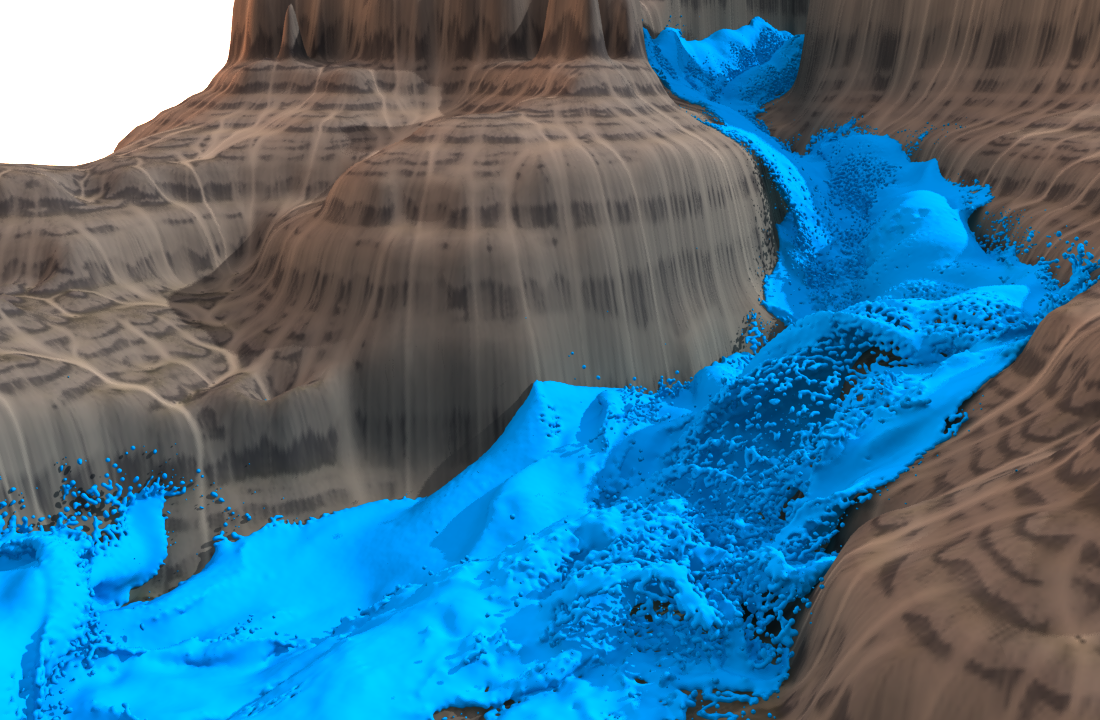
Source: SPlisHSPlasH