Maintained by SproutSeeds. Research stewardship: Fractal Research Group (frg.earth).
CLI and workspace for Paul Erdos problems.
Browse the atlas, scaffold a dossier, and keep public status, local route state, and verification records separate.







erdos-problems
atlas -> dossier -> pack -> checkpoint -> archive
erdos-problems is a CLI for working with Paul Erdos problems. It bundles problem records, local dossiers, workspace scaffolding, and pack-specific views for the problems that already have more structure in this repo.
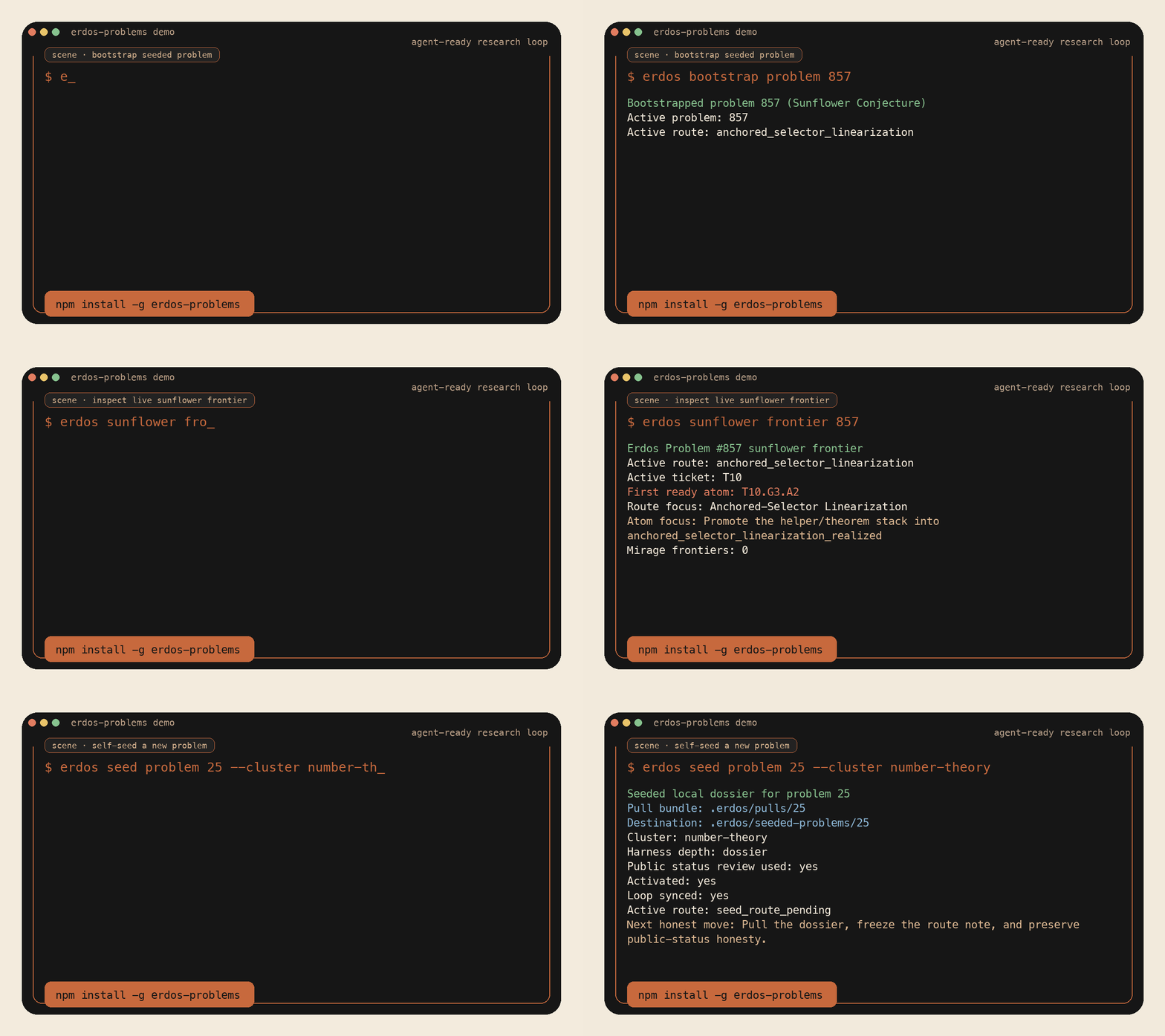
A short example from the first minute:
- a bundled external atlas import snapshot for provenance and seeding
- local dossiers and workspace bundles
- separate surfaces for public status, local route state, and verification records
- pack-specific views where this repo already has enough structure to support them
- an ORP-based workflow for claims, checkpoints, and run artifacts
- an integrated research stack surface that ties canonical imports, ORP, theorem loops, compute lanes, and writeback commands together
- a paper writer bundle mode for public-safe, citation-safe, agent-friendly drafting
SproutSeeds/erdos-problemsis the canonical public home for this project's atlas, dossiers, packs, and contribution workflow- the npm package is the installable CLI plus the bundled import snapshot, packaged dossiers, and packaged pack assets
- the GitHub repo is the broader public collaboration space for dossiers, pack packets, docs, issues, discussions, PRs, and future deep research bundles
.erdos/is local workspace state created by the CLI; it is not canonical repo trutherdos import showreports whether you are using the bundled import snapshot or a workspace-local refreshed import snapshoterdos import synccurrently refreshes an external atlas import snapshot fromteorth/erdosproblemswithout mutating the canonical local dossier layererdos import sync --write-package-snapshotis the maintainer path for intentionally updating the bundled import snapshot in this repo- most deep-research directories such as
formal/,paper/,imports/, andanalysis/remain repo-only and are intentionally kept out of npm research/frontier-engineis the current exception: it ships as an optional bundled subsystem so users can opt into GPU-oriented frontier search without making base npm install heavier- repo-only public research can live in this GitHub repo without shipping in the npm tarball; see the contribution guide: https://github.com/SproutSeeds/erdos-problems/blob/main/CONTRIBUTING.md
Install:
npm install -g erdos-problemsIf you already know the problem you want, the fastest path is:
erdos bootstrap problem 857
erdos sunflower frontier 857
erdos sunflower ready 857
erdos workspace show --json
If you want the optional frontier-engine runtime, keep it explicit:
erdos frontier doctor
erdos frontier setup --base
erdos frontier setup --cpu
erdos frontier setup --cuda --torch-index-url <url>
erdos frontier create-brev erdos-h100 --gpu-name H100 --dry-run
erdos frontier create-brev-fleet erdos-h100x2 --type hyperstack_H100 --count 2 --dry-run
erdos frontier attach-brev --instance <name> --apply
erdos frontier sync-fleet erdos-h100x2 --lane p848_anchor_ladder --apply
erdos number-theory dispatch-fleet 848 --fleet erdos-h100x2 --apply --action gpu_profile_sweep --strategy ladder_cover_v1
The Brev path is meant to be a native frontier rung: preview hardware with create-brev --dry-run, then create, attach, and sync a lane into the same SSH-backed frontier loop used by local and fixed remote boxes.
To see how the whole stack connects for the active problem:
erdos workspace show
erdos preflight
Those views now summarize:
- canonical source and import provenance
- ORP/checkpoint workflow
- theorem-loop entry and refresh commands
- compute entrypoints and hardware setup
- canonical writeback surfaces
If you want to start from a new local seed:
erdos seed problem 25 --cluster number-theory
erdos problem show 25
erdos checkpoints syncThis is the zero-assumption path for a new user.
npm install -g erdos-problemsThis gives you a global erdos command. The workspace state it creates is local to the folder you are in.
mkdir erdos-work
cd erdos-work
Later, the CLI will create a local .erdos/ directory here for workspace state, checkpoints, ORP files, and pulled artifacts.
erdos problem listUse this when you do not yet know a problem number or cluster.
erdos problem show 857This shows the title, status, cluster, short statement, and research-state posture for that problem.
erdos cluster list
erdos cluster show sunflower
Once you know what a cluster is, you can narrow the atlas:
erdos problem list --cluster sunflowererdos bootstrap problem 857What this does:
- creates
.erdos/in the current folder - activates the problem locally
- syncs the ORP kit
- scaffolds the workspace for the next research move
erdos workspace show
erdos state show
erdos problem artifacts 857 --json
Use these to understand the workspace layout, current route/frontier state, and the artifact surface that already exists for the problem.
erdos orp sync
erdos state sync
erdos preflight
This refreshes the protocol kit, recomputes local research state, and checks whether the workspace is in a sane posture to continue.
erdos continuation show
erdos continuation use route
For most new users, route is the right default. It keeps the loop focused on the current route instead of bouncing between surfaces.
erdos checkpoints syncThis writes the checkpoint shelf and keeps the workspace history honest.
erdos sunflower status 857
erdos sunflower frontier 857
erdos sunflower ready 857
This is where the problem becomes actionable instead of just descriptive.
erdos sunflower routes 857
erdos sunflower ticket 857 T10
erdos sunflower atom 857 T10.G3.A2
That is the real research loop:
- inspect route
- inspect ticket
- inspect atom
- do the next honest move
erdos state sync
erdos checkpoints sync
erdos workspace show
If the problem is not already deeply packaged, use one-step local seeding instead of bootstrapping:
erdos seed problem 25 --cluster number-theory
erdos preflight
erdos continuation use route
erdos checkpoints sync
erdos workspace show
In that flow, the seeded dossier is written under .erdos/seeded-problems/<id>/ and enters the same state/checkpoint loop as packaged dossiers.
Once a workspace already exists, this is the main operating loop:
erdos state sync
erdos preflight
erdos continuation use route
erdos checkpoints sync
erdos workspace show
Then inspect the current frontier and active unit of work:
erdos sunflower frontier 857
erdos sunflower atom 857 T10.G3.A2
After a real step, sync checkpoints again:
erdos checkpoints syncThe guiding rule is simple:
- inspect frontier
- work the next honest move
- checkpoint at honest boundaries
Initialize or resume a paper bundle:
erdos paper init 857
erdos paper show 857
Archive a solved problem:
erdos graph-theory status 1008
erdos archive scaffold 1008 --json| Surface | Coverage |
|---|---|
| Bundled external atlas snapshot | 1183 problems |
| Native packaged dossiers | 18 |
| Sunflower pack | 20, 536, 856, 857 |
| Number-theory pack | 1, 2 |
| Graph-theory archive pack | 19, 22, 1008 |
| Most developed pack problems | 20, 857 |
Seeded problems today:
1,2,3,4,5,6,7,18,19,20,21,22,89,536,542,856,857,1008
$ erdos sunflower frontier 857
Erdos Problem #857 sunflower frontier
Active route: anchored_selector_linearization
Active ticket: T10
First ready atom: T10.G3.A2
Checkpoint focus: keep the board packet honest around T10 while preserving the open-problem / active-route / route-breakthrough ladder.
$ erdos graph-theory status 1008
Erdos Problem #1008 graph-theory harness
Family role: c4_free_lean_archive
Harness profile: lean_archive_workspace
Archive mode: method_exemplar
Problem solved: yes
First ready atom: G1008.G1.A1 — Freeze the primary Lean-facing archive hook for the `C_4`-free density resulterdos bootstrap problem 857
erdos problem artifacts 857 --json
erdos checkpoints syncWhat this does:
- sets the active workspace problem
- syncs the bundled ORP kit into
.erdos/orp/ - scaffolds the dossier into
.erdos/scaffolds/<id>/ - pulls in pack-specific context where available
- prepares the workspace for the next step
erdos seed problem 25 --cluster number-theoryWhat this does:
- pulls external public metadata into a workspace bundle
- includes live site review and an agent websearch brief by default
- seeds a local dossier into
.erdos/seeded-problems/<id>/ - syncs state, checkpoints, and ORP automatically
erdos pull problem 857
erdos pull literature 857 --include-crossref --include-openalex --json
Use this when you want a research bundle first and a canonical dossier later.
erdos maintainer review problem 25 --from-pull .erdos/pulls/25
erdos maintainer seed problem 25 --from-pull .erdos/pulls/25 --cluster number-theoryerdos paper init 857
erdos paper show 857What this does:
- creates or resumes a paper bundle for the problem
- writes machine-readable public evidence and section indexes
- scaffolds claim-safe section drafts, a citation ledger, and a privacy review
- defaults to
paper/problems/<id>/when run inside this repo and to.erdos/papers/<id>/elsewhere
The sunflower pack currently covers this quartet:
20: strong / uniform sunflower core857: weak / non-uniform sunflower core536: natural-density LCM analogue856: harmonic-density LCM analogue
Useful commands:
erdos sunflower status 857
erdos sunflower board 857
erdos sunflower frontier 857
erdos sunflower routes 857
erdos sunflower tickets 857
erdos sunflower route 857 anchored_selector_linearization
erdos sunflower atom 857 T10.G3.A2
erdos sunflower compute run 857
What is included here:
- public board packets
- route / ticket / atom views
- checkpoint and report packets
- governed local-scout compute posture where a packet exists
The number-theory pack currently includes:
1: open route-oriented starter pack around a distinct-subset-sum lane2: counterexample / archive pack
Useful commands:
erdos number-theory status 1
erdos number-theory frontier 1
erdos number-theory routes 1
erdos number-theory route 1 distinct_subset_sum_lower_bound
erdos number-theory ticket 1 N1
erdos number-theory atom 1 N1.G1.A1The graph-theory archive pack currently includes:
19: decision archive pack22: proof archive pack1008: Lean-facing proof archive pack
Useful commands:
erdos graph-theory status 19
erdos graph-theory frontier 22
erdos graph-theory routes 1008
erdos graph-theory tickets 19
erdos archive scaffold 1008 --json
Design rule:
- no fake live frontier for solved or decided problems
- keep the archive usable as a method exemplar
- preserve public status discipline instead of inflating pressure where none exists
If you are using Codex, Claude Code, or another coding agent, the package provides:
- canonical dossier files
- external import provenance when available
- pack-aware context where it exists
.erdos/workspace state- ORP templates and protocol guidance
- checkpoint shelves
- explicit next-step framing
- machine-readable JSON on the main public surfaces
Useful commands for agent workflows:
erdos problem artifacts 857 --json
erdos workspace show --json
erdos pull literature 857 --include-crossref --include-openalex --json
erdos import drift 857 --jsonerdos-problems ships a bundled Open Research Protocol kit:
PROTOCOL.mdAGENT_INTEGRATION.mdtemplates/CLAIM.mdtemplates/VERIFICATION_RECORD.mdtemplates/FAILED_TOPIC.md
When the global orp CLI is available, erdos-problems can also broker ORP research runs for source audits, discovery questions, and breakthrough scouting:
erdos orp research status --json
erdos orp research ask 848 --question "Check whether this source changes the current proof route" --json
erdos orp research ask 848 --question "Check whether this source changes the current proof route" --execute --allow-paid --json
erdos orp research openai-check --json
erdos orp research openai-check --execute --allow-paid --json
erdos orp research usage --json
The safe default is planning-only: live OpenAI API calls require both --execute and --allow-paid unless ERDOS_ORP_RESEARCH_ALLOW_PAID=1 is set for an intentional paid-call session. A workspace-local daily live-run guard defaults to 10 and can be lowered with ERDOS_ORP_RESEARCH_DAILY_LIMIT=0 to disable live calls. A local daily research API budget defaults to $5 via ERDOS_ORP_RESEARCH_DAILY_USD_LIMIT; set it to 0 to disable paid research spend. The guard reserves $1 for normal research asks and $0.05 for smoke checks unless ERDOS_ORP_RESEARCH_ESTIMATED_COST_USD overrides the estimate. This is a local agent/workspace budget guard, not an upstream provider billing hard cap. Use live research for high-leverage source audits, theorem wedges, external reference checks, or repeated local stalls; avoid it for routine tests or deterministic local compute. ORP resolves OPENAI_API_KEY from the environment or the local openai-primary Keychain secret, and secret values are not written to research artifacts.
The package keeps these layers separate:
- canonical repo truth
- external imported public truth
- workspace bundle truth
- pack-specific route / checkpoint / run truth
- ORP research-run truth
erdos problem list --cluster sunflower
erdos problem show 857
erdos problem artifacts 857 --json

erdos cluster list --json
erdos cluster show graph-theory

erdos workspace show --json
erdos checkpoints sync
erdos preflight

erdos sunflower frontier 857
erdos sunflower ready 857
erdos sunflower compute run 857

erdos number-theory route 1 distinct_subset_sum_lower_bound
erdos graph-theory status 1008

erdos pull problem 857
erdos pull literature 857 --include-crossref --include-openalex --json

erdos seed problem 25 --cluster number-theory
erdos maintainer review problem 25 --from-pull .erdos/pulls/25
erdos archive scaffold 1008 --json- canonical repo: https://github.com/SproutSeeds/erdos-problems
- local dossier truth:
problems/<id>/problem.yaml - bundled external import snapshot:
data/upstream/erdosproblems/ - workspace external import snapshot:
.erdos/upstream/erdosproblems/ - external atlas import repo: https://github.com/teorth/erdosproblems
- external public site: https://www.erdosproblems.com/
docs/ERDOS_PROBLEMS_REPO_SPEC.mddocs/ERDOS_PROBLEMS_PROBLEM_SCHEMA.mddocs/ERDOS_SUNFLOWER_CLUSTER_SEED_PLAN.mddocs/RESEARCH_LOOP.mddocs/LAUNCH_KIT.md
If you are preparing a public post, start here:
- docs/LAUNCH_KIT.md
assets/social-card.svgassets/terminal-demo.gif
erdosproblems.com is an external public problem source. erdos-problems imports from public sources when helpful, but keeps its canonical dossiers, packs, workflow, and contribution surface in this repo.
Yes. The package can scaffold a local .erdos/ workspace, expose machine-readable JSON on the main public surfaces, and keep public status, local route state, and verification records separate.
The sunflower pack is currently the most developed. Problems 20 and 857 have the deepest public pack surface. Problems 536 and 856 are included as bridge-oriented sunflower dossiers. The number-theory and graph-theory packs are lighter.
No. The bundled upstream atlas covers open, solved, and decided problems. Open problems can be seeded into active workspaces. Solved or decided problems can be scaffolded in archive mode and used as method exemplars.
A dossier is the local canonical folder for one problem. It usually includes problem.yaml, STATEMENT.md, REFERENCES.md, EVIDENCE.md, and FORMALIZATION.md.
No. You can start with erdos bootstrap problem <id> or erdos seed problem <id>. ORP files are bundled into the workspace for structured claims and checkpoints, and some packs include formalization-specific surfaces, but the first step does not require Lean.
erdos-problems is the canonical npm package name and it is already live on npm. The compact unscoped alias erdosproblems is not publishable because npm rejects it as too similar to erdos-problems.