
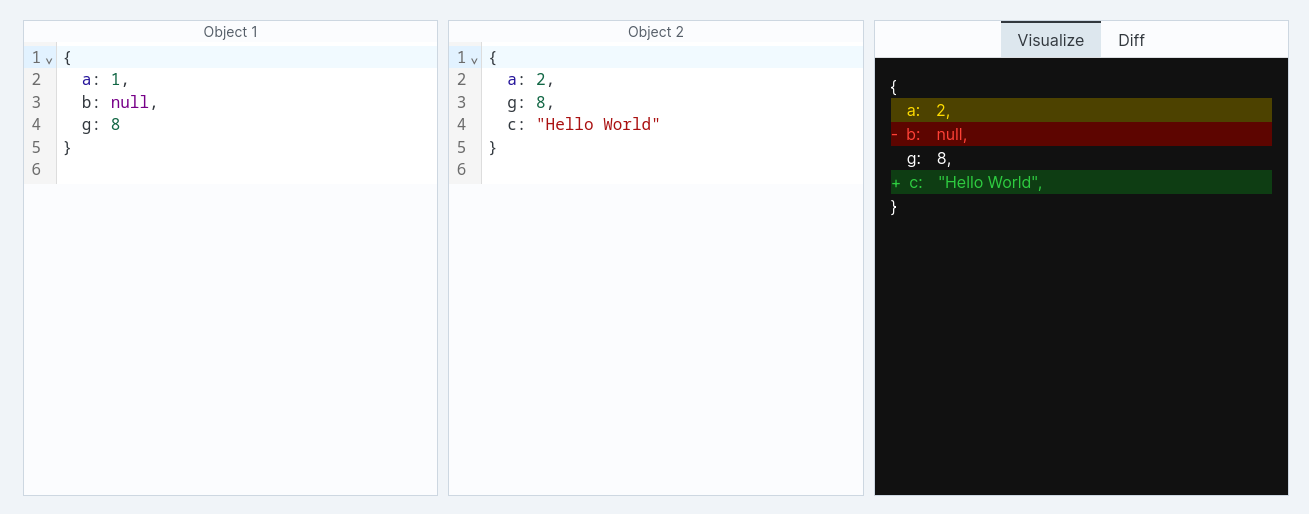

The Fast, Accurate, and Modern JavaScript Objects Diffing & Patching Library.
- 🔍 Deep Objects Diffing: Detects changes at any depth.
- ✂️ Compact Array Diffs: Shortest edit scripts (Myers LCS) — inserting one element into a 10k array yields 1 op, not 10,001.
- 🩹 Efficient Patching: Apply diffs to recreate target objects.
- 🧬 Type-Safe Serialization: Round-trip diffs across network/process boundaries with
serializeanddeserializepreserving all JS native types. - 🛠️ Extensible: Support for custom object types via
diffWith(). - 📦 Modern Ecosystem: Built for Bun, Node.js, Deno, and Browser.
- 🟦 TypeScript Native: Full type safety and autocompletion.
- ⚡ High Performance: Optimized for speed and minimal memory footprint.
Install @opentf/obj-diff using your preferred package manager:
# Bun
bun add @opentf/obj-diff

# pnpm
pnpm add @opentf/obj-diff

# npm
npm install @opentf/obj-diff

# yarn
yarn add @opentf/obj-diff

# Deno
deno add @opentf/obj-diffThe library natively supports the following types:
- Primitives:
Undefined,Null,Number,String,Boolean,BigInt. - Built-in Objects:
Plain Objects {},Array,Date,Map,Set,TypedArray(Uint8Array,Float32Array, etc.),ArrayBuffer,DataView. - Temporal: all
Temporaltypes (Instant,PlainDate,PlainTime,PlainDateTime,PlainYearMonth,PlainMonthDay,ZonedDateTime,Duration) — compared as immutable values (Durationstructurally by its canonical string, since it has no.equals()). - Class Instances: instances sharing the same prototype are diffed by their own enumerable properties; instances of different classes are reported as replaced.
Performs a deep comparison between two objects.
import { diff } from '@opentf/obj-diff';

const result = diff(obj1, obj2);type DiffResult = {
type: 0 | 1 | 2 | 3 | 4; // 0: Deleted, 1: Added, 2: Changed,
// 3: Inserted (array splice-in), 4: Removed (array splice-out)
path: Array<unknown>; // path to the property; Map entries use the Map key itself
value?: unknown; // the new value (for types 1, 2 and 3)
};Types 3 (INSERTED) and 4 (REMOVED) are array-only splice operations with application-time indexes — they are what make array diffs compact:
diff([1, 2, 3], [0, 1, 2, 3]);
//=> [{ type: 3, path: [0], value: 0 }]  // 1 op, not 4
The constants (DELETED, ADDED, CHANGED, INSERTED, REMOVED) are exported from the package root.
Applies an array of diff results to an object.
import { patch } from "@opentf/obj-diff";

const updatedObj = patch(originalObj, diffResults);A diff is forward-only: it does not contain the old values needed to derive an inverse later. Store both directions while both states are available:
const change = {
  redo: diff(previous, next),
  undo: diff(next, previous),
};

state = patch(state, change.redo);
state = patch(state, change.undo);A diff holds live values by reference, so JSON.stringify loses their types (Date→string, Map/Set→{}, BigInt→throws). Use serialize/deserialize to send a diff across a process or network boundary and patch it back into the correct types on the other side:
import { diff, patch, serialize, deserialize } from "@opentf/obj-diff";

// client
const wire = serialize(diff(a, b)); // a JSON string, type-safe

// server
const patched = patch(a, deserialize(wire)); // Date/Map/Set/… restored exactly
value stays readable — each special value becomes a reference token "@n", with the real types collected in a per-op $refs table:
{
  "type": 1,
  "path": ["user"],
  "value": { "id": 1, "lastSeen": "@1", "roles": "@2" },
  "$refs": {
    "1": { "_t": "Date", "_v": "2026-07-15T00:00:00.000Z" },
    "2": { "_t": "Set", "_v": ["admin", "editor"] }
  }
}
Every supported type is preserved (Date, RegExp, Map, Set, TypedArray, ArrayBuffer, DataView, Error, URL, BigInt, Temporal, …), nested to any depth. Circular references and objects shared by identity are rebuilt with the same identity on the far side — including cycles through a Map/Set/Error; single-use plain containers stay inline. Symbols, functions and class instances throw (a SerializeError). Deserializing a Temporal value requires a Temporal implementation on globalThis.
The codec itself is @opentf/serialize: serialize/deserialize shape its low-level encode/decode into the per-op diff format above, and stringify/parse are re-exported unchanged.
Need the same type-safe codec for any value, not just a diff? stringify/parse are the general-purpose counterpart — a drop-in, richer JSON.stringify/JSON.parse that keeps native types intact:
import { stringify, parse } from "@opentf/obj-diff";

const wire = stringify({
  when: new Date(),
  tags: new Set(["a", "b"]),
  prefs: new Map([["theme", "dark"]]),
  big: 42n,
});

const value = parse(wire); // Date / Set / Map / BigInt all restored
Same coverage as above — every native type, plus circular references and shared identity. Symbols, functions, and class instances throw.
const a = { a: 1, b: 2 };
const b = { a: 2, c: 3 };

diff(a, b);
/*
[
  { type: 2, path: ["a"], value: 2 },
  { type: 0, path: ["b"] },
  { type: 1, path: ["c"], value: 3 }
]
*/const a = { foo: { bar: [1, 2] } };
const b = { foo: { bar: [1] } };
const d = diff(a, b);
const res = patch(a, d); // res is deep equal to bNatively diff and patch modern collections.
const a = new Set([1, 2]);
const b = new Set([2, 3]);

diff(a, b);
/*
[
  { type: 2, path: [0], value: 2 },
  { type: 2, path: [1], value: 3 }
]
*/Safe comparison of recursive objects without infinite loops.
const a = { id: 1 };
a.self = a;
const b = { id: 2 };
b.self = b;

diff(a, b);
// Output: [{ type: 2, path: ["id"], value: 2 }]Extend the diffing logic for specialized types like MongoDB ObjectId.
import { diffWith } from "@opentf/obj-diff";
import { ObjectId } from "bson";

const result = diffWith(record1, record2, (a, b) => {
  if (a instanceof ObjectId && b instanceof ObjectId) {
    return a.toString() !== b.toString();
  }
});For maximum performance, @opentf/obj-diff preserves internal object identity (sharing) during the patch() operation.
If your original object contains multiple paths pointing to the same object instance, patching one of those paths will affect all its aliases.
const shared = { x: 1 };
const a = { first: shared, second: shared };
const b = { first: { x: 1 }, second: { x: 2 } };

const d = diff(a, b);
const res = patch(a, d);

// res.first.x will be 2 because it shares the same instance as res.second
console.log(res.first.x); // 2
Tip
If you require independent branches after patching, ensure your input objects do not share internal references that are expected to diverge.
The benchmark suite lives in benchmarks/, built on mitata. Its output is rendered live on the site — the Benchmarks page for diff size and speed, and the Comparison page for the native-type accuracy matrix. Every number there is generated by tsr benchmarks:collect and rendered straight from its JSON output — nothing is typed by hand, so the tables cannot drift from the code.
Op counts don't depend on the machine. This is where compact array diffs pay off — one operation per actual edit, not one per shifted element:
| Edit on a 10,000-element array | @opentf/obj-diff |
microdiff |
|---|---|---|
| Insert 1 element at the front | 1 | 10,001 |
| Insert 1 element in the middle | 1 | 5,001 |
| Remove 1 element from the middle | 1 | 5,000 |
| Remove a run of 10 elements | 10 | 5,000 |
The accuracy matrix answers the most important question — whether a library notices a change at all. @opentf/obj-diff is the only library in the matrix that catches changes inside both Map and Set; most JSON-oriented differs silently report []. See the full matrix on the Comparison page.
See the live Benchmarks page: diff speed across eight libraries, diff + patch round-trips, and honest notes on the cases where a positional differ wins. In short — within a whisker of the fastest differ on small objects, roughly 66× faster than microdiff on TypedArrays (a native compare instead of an element-wise walk), and orders of magnitude ahead of heavyweight libraries like jsondiffpatch on large arrays.
tsr benchmarks:collect # diff, patch, and native-type accuracy tablesThe JSON Patch protocol is quite heavy and complex. We've optimized @opentf/obj-diff for performance and simplicity, which covers the vast majority of real-world use cases.
An empty path denotes the Root of the object. It typically means the entire source was replaced by the target value (e.g., comparing an object to null).
This project is licensed under the MIT License.