Let's start with a problem~
For example: triangle
Given a triangle, find the minimum path sum from top to bottom. Each step you may move to an adjacent node in the row below.
For example, given the following triangle:
[
     [2],
    [3,4],
   [6,5,7],
  [4,1,8,3]
]
The minimum path sum from top to bottom is 11 (i.e., 2 + 3 + 5 + 1 = 11).
Use DFS (traversal or divide and conquer)
Traversal
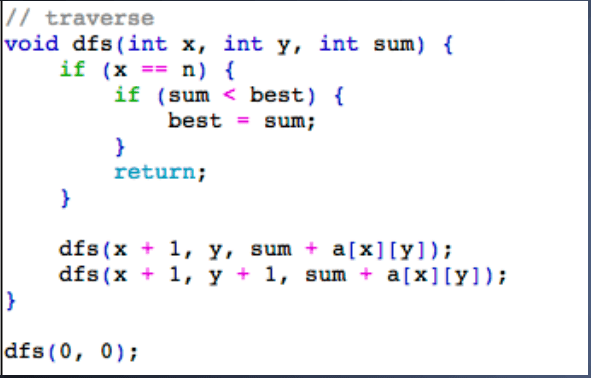
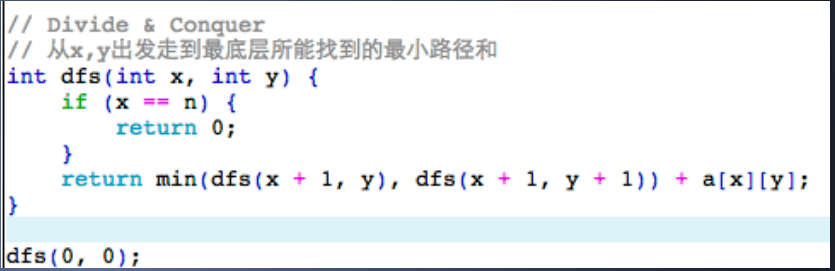
Divide and conquer
Optimize DFS by caching values that have already been computed (called: memoization; essentially: dynamic programming)
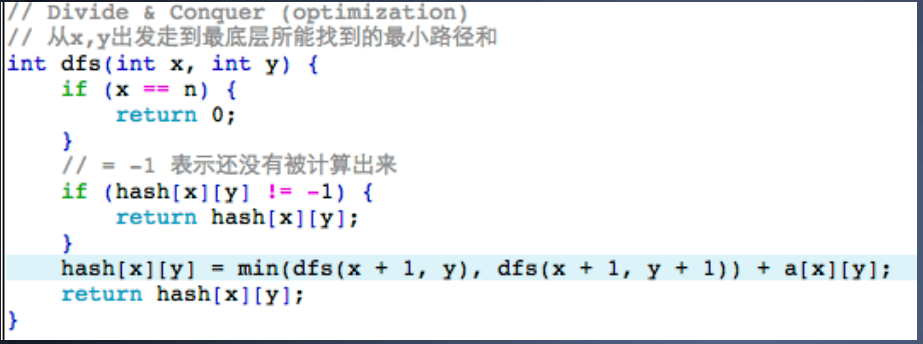
Dynamic programming turns a big problem into small problems, and the method that solves the issue of repeated computation of subproblems is called dynamic programming.
The difference between dynamic programming and DFS
- For a binary tree, the subproblems have no intersection, so most binary tree problems can be solved with recursion or divide and conquer, i.e., DFS.
- For a problem like triangle, where there are repeated paths, the subproblems intersect, so it can be solved with dynamic programming.
Dynamic programming, bottom-up
func minimumTotal(triangle [][]int) int {
	if len(triangle) == 0 || len(triangle[0]) == 0 {
		return 0
	}
	// 1. State definition: f[i][j] represents the shortest path from i,j to the last row
	var l = len(triangle)
	var f = make([][]int, l)
	// 2. Initialization
	for i := 0; i < l; i++ {
		for j := 0; j < len(triangle[i]); j++ {
			if f[i] == nil {
				f[i] = make([]int, len(triangle[i]))
			}
			f[i][j] = triangle[i][j]
		}
	}
	// 3. Solve by recurrence
	for i := len(triangle) - 2; i >= 0; i-- {
		for j := 0; j < len(triangle[i]); j++ {
			f[i][j] = min(f[i+1][j], f[i+1][j+1]) + triangle[i][j]
		}
	}
	// 4. Answer
	return f[0][0]
}
func min(a, b int) int {
	if a > b {
		return b
	}
	return a
}
Dynamic programming, top-down
// Test case:
// [
// [2],
// [3,4],
// [6,5,7],
// [4,1,8,3]
// ]
func minimumTotal(triangle [][]int) int {
    if len(triangle) == 0 || len(triangle[0]) == 0 {
        return 0
    }
    // 1. State definition: f[i][j] represents the shortest path from 0,0 to i,j
    var l = len(triangle)
    var f = make([][]int, l)
    // 2. Initialization
    for i := 0; i < l; i++ {
        for j := 0; j < len(triangle[i]); j++ {
            if f[i] == nil {
                f[i] = make([]int, len(triangle[i]))
            }
            f[i][j] = triangle[i][j]
        }
    }
    // Solve by recurrence
    for i := 1; i < l; i++ {
        for j := 0; j < len(triangle[i]); j++ {
            // There are two cases here:
            // 1. The previous row has no left value
            // 2. The previous row has no right value
            if j-1 < 0 {
                f[i][j] = f[i-1][j] + triangle[i][j]
            } else if j >= len(f[i-1]) {
                f[i][j] = f[i-1][j-1] + triangle[i][j]
            } else {
                f[i][j] = min(f[i-1][j], f[i-1][j-1]) + triangle[i][j]
            }
        }
    }
    result := f[l-1][0]
    for i := 1; i < len(f[l-1]); i++ {
        result = min(result, f[l-1][i])
    }
    return result
}
func min(a, b int) int {
    if a > b {
        return b
    }
    return a
}Recursion is a way of implementing a program: a function calling itself
Function(x) {
	...
	Funciton(x-1);
	...
}
Dynamic programming: it is a way of thinking to solve problems, where the result of a large-scale problem is computed from the results of smaller-scale problems. Dynamic programming can be implemented with recursion (Memorization Search).
Two conditions must be satisfied:
- Satisfy one of the following:
- Find the maximum/minimum value (Maximum/Minimum)
- Determine feasibility (Yes/No)
- Count the number of feasible solutions (Count(*))
- Cannot be sorted or swapped (Can not sort / swap)
For example: longest-consecutive-sequence — positions can be swapped, so dynamic programming is not used.
- State
- Inspiration, creativity; storing the results of small-scale problems
- Function
- The relationship between states; how to compute a larger state from smaller states
- Initialization
- What is the smallest extreme state, the starting point
- Answer
- What is the largest state, the ending point
- Matrix DP (10%)
- Sequence (40%)
- Two Sequences DP (40%)
- Backpack (10%)
Notes
- Most greedy algorithm problems rely on memorizing answers, so if dynamic programming can be used, prefer dynamic programming over greedy algorithms.
Given an m x n grid filled with non-negative integers, find a path from the top-left corner to the bottom-right corner that minimizes the sum of the numbers along the path.
Idea: dynamic programming
- state: f[x][y] is the shortest path from the start to x,y
- function: f[x][y] = min(f[x-1][y], f[x][y-1]) + A[x][y]
- initialize: f[0][0] = A[0][0], f[i][0] = sum(0,0 -> i,0), f[0][i] = sum(0,0 -> 0,i)
- answer: f[n-1][m-1]
func minPathSum(grid [][]int) int {
    // Idea: dynamic programming
    // f[i][j] represents the minimum sum from i,j to 0,0
    if len(grid) == 0 || len(grid[0]) == 0 {
        return 0
    }
    // Reuse the original matrix list
    // Initialization: f[i][0], f[0][j]
    for i := 1; i < len(grid); i++ {
        grid[i][0] = grid[i][0] + grid[i-1][0]
    }
    for j := 1; j < len(grid[0]); j++ {
        grid[0][j] = grid[0][j] + grid[0][j-1]
    }
    for i := 1; i < len(grid); i++ {
        for j := 1; j < len(grid[i]); j++ {
            grid[i][j] = min(grid[i][j-1], grid[i-1][j]) + grid[i][j]
        }
    }
    return grid[len(grid)-1][len(grid[0])-1]
}
func min(a, b int) int {
    if a > b {
        return b
    }
    return a
}A robot is located at the top-left corner of an m x n grid (the start point is marked "Start" in the figure below). The robot can only move down or right one step at a time. The robot is trying to reach the bottom-right corner of the grid (marked "Finish" in the figure below). How many distinct paths are there in total?
func uniquePaths(m int, n int) int {
	// f[i][j] represents the number of paths from i,j to 0,0
	f := make([][]int, m)
	for i := 0; i < m; i++ {
		for j := 0; j < n; j++ {
			if f[i] == nil {
				f[i] = make([]int, n)
			}
			f[i][j] = 1
		}
	}
	for i := 1; i < m; i++ {
		for j := 1; j < n; j++ {
			f[i][j] = f[i-1][j] + f[i][j-1]
		}
	}
	return f[m-1][n-1]
}A robot is located at the top-left corner of an m x n grid (the start point is marked "Start" in the figure below). The robot can only move down or right one step at a time. The robot is trying to reach the bottom-right corner of the grid (marked "Finish" in the figure below). How many distinct paths are there in total? Now consider that there are obstacles in the grid. How many distinct paths are there from the top-left corner to the bottom-right corner?
func uniquePathsWithObstacles(obstacleGrid [][]int) int {
	// f[i][j] = f[i-1][j] + f[i][j-1] and check for obstacles
	if obstacleGrid[0][0] == 1 {
		return 0
	}
	m := len(obstacleGrid)
	n := len(obstacleGrid[0])
	f := make([][]int, m)
	for i := 0; i < m; i++ {
		for j := 0; j < n; j++ {
			if f[i] == nil {
				f[i] = make([]int, n)
			}
			f[i][j] = 1
		}
	}
	for i := 1; i < m; i++ {
		if obstacleGrid[i][0] == 1 || f[i-1][0] == 0 {
			f[i][0] = 0
		}
	}
	for j := 1; j < n; j++ {
		if obstacleGrid[0][j] == 1 || f[0][j-1] == 0 {
			f[0][j] = 0
		}
	}
	for i := 1; i < m; i++ {
		for j := 1; j < n; j++ {
			if obstacleGrid[i][j] == 1 {
				f[i][j] = 0
			} else {
				f[i][j] = f[i-1][j] + f[i][j-1]
			}
		}
	}
	return f[m-1][n-1]
}Suppose you are climbing stairs. It takes n steps to reach the top.
func climbStairs(n int) int {
    // f[i] = f[i-1] + f[i-2]
    if n == 1 || n == 0 {
        return n
    }
    f := make([]int, n+1)
    f[1] = 1
    f[2] = 2
    for i := 3; i <= n; i++ {
        f[i] = f[i-1] + f[i-2]
    }
    return f[n]
}Given an array of non-negative integers, you are initially positioned at the first index of the array. Each element in the array represents your maximum jump length at that position. Determine if you are able to reach the last index.
func canJump(nums []int) bool {
    // Idea: look at the last jump
    // State: f[i] represents whether you can jump from 0 to i
    // Derivation: f[i] = OR(f[j], j<i && j can jump to i) — check whether the last jump from any previous point can reach the current point
    // Initialization: f[0] = 0
    // Result: f[n-1]
    if len(nums) == 0 {
        return true
    }
    f := make([]bool, len(nums))
    f[0] = true
    for i := 1; i < len(nums); i++ {
        for j := 0; j < i; j++ {
            if f[j] == true && nums[j]+j >= i {
                f[i] = true
            }
        }
    }
    return f[len(nums)-1]
}Given an array of non-negative integers, you are initially positioned at the first index of the array. Each element in the array represents your maximum jump length at that position. Your goal is to reach the last index in the minimum number of jumps.
// v1 dynamic programming (other languages may time out; refer to v2)
func jump(nums []int) int {
    // State: f[i] represents the minimum number of jumps from the start to the current position
    // Derivation: f[i] = f[j], a[j]+j >= i, min(f[j]+1)
    // Initialization: f[0] = 0
    // Result: f[n-1]
    f := make([]int, len(nums))
    f[0] = 0
    for i := 1; i < len(nums); i++ {
        // The maximum value of f[i] is i
        f[i] = i
        // Iterate over previous results and take the minimum + 1
        for j := 0; j < i; j++ {
            if nums[j]+j >= i {
                f[i] = min(f[j]+1,f[i])
            }
        }
    }
    return f[len(nums)-1]
}
func min(a, b int) int {
    if a > b {
        return b
    }
    return a
}
// v2 dynamic programming + greedy optimization
func jump(nums []int) int {
n:=len(nums)
f := make([]int, n)
f[0] = 0
for i := 1; i < n; i++ {
// Take the first point that can jump to the current position
// Since the result set of jump counts is monotonically increasing, the greedy approach is correct
idx:=0
for idx<n&&idx+nums[idx]<i{
idx++
}
f[i]=f[idx]+1
}
return f[n-1]
}Given a string s, partition s such that every substring of the partition is a palindrome. Return the minimum number of cuts needed.
func minCut(s string) int {
	// state: f[i] is the minimum number of cuts needed for the substring formed by the "first i" characters (count - 1 is the index)
	// function: f[i] = MIN{f[j]+1}, j < i && [j+1 ~ i] is a palindrome
	// initialize: f[i] = i - 1 (f[0] = -1)
	// answer: f[s.length()]
	if len(s) == 0 || len(s) == 1 {
		return 0
	}
	f := make([]int, len(s)+1)
	f[0] = -1
	f[1] = 0
	for i := 1; i <= len(s); i++ {
		f[i] = i - 1
		for j := 0; j < i; j++ {
			if isPalindrome(s, j, i-1) {
				f[i] = min(f[i], f[j]+1)
			}
		}
	}
	return f[len(s)]
}
func min(a, b int) int {
	if a > b {
		return b
	}
	return a
}
func isPalindrome(s string, i, j int) bool {
	for i < j {
		if s[i] != s[j] {
			return false
		}
		i++
		j--
	}
	return true
}
Note
- When checking palindromic substrings, you can precompute them with dynamic programming to reduce time complexity.
Given an unsorted array of integers, find the length of the longest increasing subsequence.
func lengthOfLIS(nums []int) int {
    // f[i] represents the length of the longest subsequence ending at i, starting from 0
    // f[i] = max(f[j])+1, a[j]<a[i]
    // f[0...n-1] = 1
    // max(f[0]...f[n-1])
    if len(nums) == 0 || len(nums) == 1 {
        return len(nums)
    }
    f := make([]int, len(nums))
    f[0] = 1
    for i := 1; i < len(nums); i++ {
        f[i] = 1
        for j := 0; j < i; j++ {
            if nums[j] < nums[i] {
                f[i] = max(f[i], f[j]+1)
            }
        }
    }
    result := f[0]
    for i := 1; i < len(nums); i++ {
        result = max(result, f[i])
    }
    return result

}
func max(a, b int) int {
    if a > b {
        return a
    }
    return b
}Given a non-empty string s and a dictionary wordDict containing a list of non-empty words, determine whether s can be segmented into a space-separated sequence of one or more dictionary words.
func wordBreak(s string, wordDict []string) bool {
	// f[i] represents whether the first i characters can be segmented
	// f[i] = f[j] && s[j+1~i] in wordDict
	// f[0] = true
	// return f[len]

	if len(s) == 0 {
		return true
	}
	f := make([]bool, len(s)+1)
	f[0] = true
	max,dict := maxLen(wordDict)
	for i := 1; i <= len(s); i++ {
		l := 0
		if i - max > 0 {
			l = i - max
		}
		for j := l; j < i; j++ {
			if f[j] && inDict(s[j:i],dict) {
				f[i] = true
                break
			}
		}
	}
	return f[len(s)]
}


func maxLen(wordDict []string) (int,map[string]bool) {
    dict := make(map[string]bool)
	max := 0
	for _, v := range wordDict {
		dict[v] = true
		if len(v) > max {
			max = len(v)
		}
	}
	return max,dict
}

func inDict(s string,dict map[string]bool) bool {
	_, ok := dict[s]
	return ok
}
Summary
A common approach is to use position 0 as a placeholder, so that problems can be handled uniformly. The initialization then uses length+1 on top of the original, and the result returned is f[n].
- The state can be "the first i"
- Initialize with length+1
- Access with index = i-1
- Return value: f[n] or f[m][n]
Given two strings text1 and text2, return the longest common subsequence of these two strings. A subsequence of a string is a new string generated from the original string with some characters (can be none) deleted without changing the relative order of the remaining characters. For example, "ace" is a subsequence of "abcde", but "aec" is not a subsequence of "abcde". A "common subsequence" of two strings is a subsequence that is common to both strings.
func longestCommonSubsequence(a string, b string) int {
    // dp[i][j] is the longest common subsequence of the first i characters of a and the first j characters of b
    // dp[m+1][n+1]
    //   ' a d c e
    // ' 0 0 0 0 0
    // a 0 1 1 1 1
    // c 0 1 1 2 1
    //
    dp:=make([][]int,len(a)+1)
    for i:=0;i<=len(a);i++ {
        dp[i]=make([]int,len(b)+1)
    }
    for i:=1;i<=len(a);i++ {
        for j:=1;j<=len(b);j++ {
            // If equal, take the top-left element + 1; otherwise take the larger of left or top
            if a[i-1]==b[j-1] {
                dp[i][j]=dp[i-1][j-1]+1
            } else {
                dp[i][j]=max(dp[i-1][j],dp[i][j-1])
            }
        }
    }
    return dp[len(a)][len(b)]
}
func max(a,b int)int {
    if a>b{
        return a
    }
    return b
}
Note
- Go slice initialization
dp:=make([][]int,len(a)+1)
for i:=0;i<=len(a);i++ {
    dp[i]=make([]int,len(b)+1)
}- Iterate from 1 to the maximum length
- The index needs to be decremented by one
Given two words word1 and word2, compute the minimum number of operations required to convert word1 into word2. You may perform the following three operations on a word: Insert a character Delete a character Replace a character
Idea: very similar to the previous problem. If equal, no operation is needed; otherwise take the minimum of the delete, insert, and replace operations + 1.
func minDistance(word1 string, word2 string) int {
    // dp[i][j] represents the minimum number of operations to edit the first i characters of string a into the first j characters of string b
    // dp[i][j] = OR(dp[i-1][j-1], a[i]==b[j], min(dp[i-1][j],dp[i][j-1],dp[i-1][j-1])+1)
    dp:=make([][]int,len(word1)+1)
    for i:=0;i<len(dp);i++{
        dp[i]=make([]int,len(word2)+1)
    }
    for i:=0;i<len(dp);i++{
        dp[i][0]=i
    }
    for j:=0;j<len(dp[0]);j++{
        dp[0][j]=j
    }
    for i:=1;i<=len(word1);i++{
        for j:=1;j<=len(word2);j++{
            // If equal, no operation is needed
            if word1[i-1]==word2[j-1] {
                dp[i][j]=dp[i-1][j-1]
            }else{ // Otherwise take the minimum of delete, insert, replace + 1
                dp[i][j]=min(min(dp[i-1][j],dp[i][j-1]),dp[i-1][j-1])+1
            }
        }
    }
    return dp[len(word1)][len(word2)]
}
func min(a,b int)int{
    if a>b{
        return b
    }
    return a
}
Note
Another approach: MAXLEN(a,b)-LCS(a,b)
Given coins of different denominations and a total amount, write a function to compute the fewest number of coins needed to make up that amount. If that amount cannot be made up by any combination of the coins, return -1.
Idea: a bit different from other DP problems — here i represents money or capacity.
func coinChange(coins []int, amount int) int {
    // State dp[i] represents the minimum number of coins to make up amount i
    // Derivation dp[i] = min(dp[i-1], dp[i-2], dp[i-5])+1, on the condition that i-coins[j] > 0
    // Initialize to the maximum value dp[i]=amount+1
    // Return value dp[n], or if dp[n]>amount => -1
    dp:=make([]int,amount+1)
    for i:=0;i<=amount;i++{
        dp[i]=amount+1
    }
    dp[0]=0
    for i:=1;i<=amount;i++{
        for j:=0;j<len(coins);j++{
            if  i-coins[j]>=0  {
                dp[i]=min(dp[i],dp[i-coins[j]]+1)
            }
        }
    }
    if dp[amount] > amount {
        return -1
    }
    return dp[amount]

}
func min(a,b int)int{
    if a>b{
        return b
    }
    return a
}
Note
dp[i-a[j]] decides whether a[j] participates
Given n items, select some items to put into a backpack. How full can it be at most? Assume the backpack size is m, and the size of each item is A[i].
func backPack (m int, A []int) int {
    // write your code here
    // f[i][j] represents whether the first i items can fill capacity j
    // f[i][j] = f[i-1][j], f[i-1][j-a[i]] when j>a[i]
    // f[0][0]=true f[...][0]=true
    // f[n][X]
    f:=make([][]bool,len(A)+1)
    for i:=0;i<=len(A);i++{
        f[i]=make([]bool,m+1)
    }
    f[0][0]=true
    for i:=1;i<=len(A);i++{
        for j:=0;j<=m;j++{
            f[i][j]=f[i-1][j]
            if j-A[i-1]>=0 && f[i-1][j-A[i-1]]{
                f[i][j]=true
            }
        }
    }
    for i:=m;i>=0;i--{
        if f[len(A)][i] {
            return i
        }
    }
    return 0
}There are
nitems and a backpack of sizem. The arrayAgives the size of each item and the arrayVgives the value of each item. What is the maximum total value that can be put into the backpack?
Idea: f[i][j] is the maximum value of putting the first i items into a backpack of capacity j
func backPackII (m int, A []int, V []int) int {
    // write your code here
    // f[i][j] is the maximum value of putting the first i items into a backpack of capacity j
    // f[i][j] = max(f[i-1][j], f[i-1][j-A[i]]+V[i]) — whether to add item A[i]
    // f[0][0]=0 f[0][...]=0 f[...][0]=0
    f:=make([][]int,len(A)+1)
    for i:=0;i<len(A)+1;i++{
        f[i]=make([]int,m+1)
    }
    for i:=1;i<=len(A);i++{
        for j:=0;j<=m;j++{
            f[i][j]=f[i-1][j]
            if j-A[i-1] >= 0{
                f[i][j]=max(f[i-1][j],f[i-1][j-A[i-1]]+V[i-1])
            }
        }
    }
    return f[len(A)][m]
}
func max(a,b int)int{
    if a>b{
        return a
    }
    return b
}Matrix DP (10%)
Sequence (40%)
- climbing-stairs
- jump-game
- jump-game-ii
- palindrome-partitioning-ii
- longest-increasing-subsequence
- word-break
Two Sequences DP (40%)
Backpack & Coin Change (10%)