Backtracking is commonly used to traverse all subsets of a list. It is a form of DFS (depth-first search), generally used for permutations and exhaustively enumerating all possibilities. The traversal process is actually the traversal of a decision tree. The time complexity is generally O(N!). Unlike dynamic programming, it has no overlapping subproblems that can be optimized; backtracking is pure brute-force enumeration, and its complexity is generally very high.
result = []
func backtrack(choice list, path):
    if meets the termination condition:
        result.add(path)
        return
    for choice in choice list:
        make a choice
        backtrack(choice list, path)
        undo the choice
The core idea is to make a choice from the choice list, then keep recursing downward to search for the answer. If a path leads nowhere, return and undo this choice.
Given an integer array nums containing no duplicate elements, return all possible subsets (the power set) of the array.
Traversal process
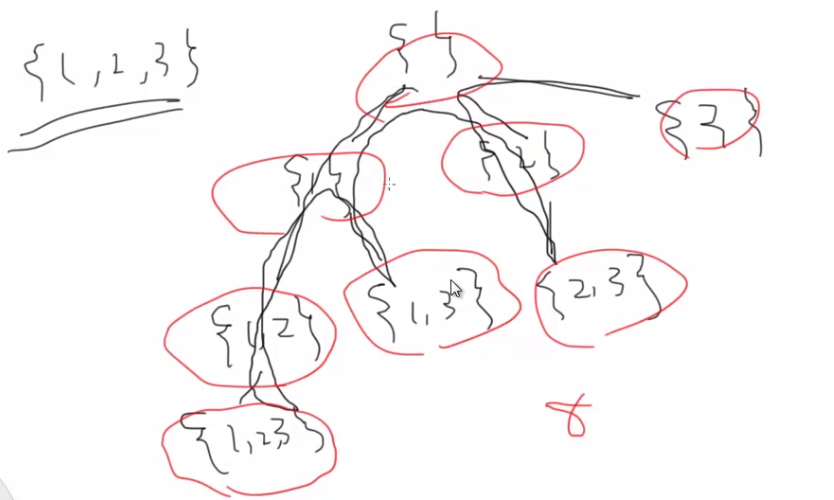
func subsets(nums []int) [][]int {
	// Save the final result
	result := make([][]int, 0)
	// Save the intermediate result
	list := make([]int, 0)
	backtrack(nums, 0, list, &result)
	return result
}

// nums the given set
// pos the index position of the next element to add to the set
// list temporary result set (needs to be copied and saved each time)
// result the final result
func backtrack(nums []int, pos int, list []int, result *[][]int) {
	// Copy the temporary result out and save it to the final result
	ans := make([]int, len(list))
	copy(ans, list)
	*result = append(*result, ans)
	// Make a choice, process the result, then undo the choice
	for i := pos; i < len(nums); i++ {
		list = append(list, nums[i])
		backtrack(nums, i+1, list, result)
		list = list[0 : len(list)-1]
	}
}Given an integer array nums that may contain duplicate elements, return all possible subsets (the power set) of the array. Note: the solution set must not contain duplicate subsets.
import (
	"sort"
)

func subsetsWithDup(nums []int) [][]int {
	// Save the final result
	result := make([][]int, 0)
	// Save the intermediate result
	list := make([]int, 0)
	// Sort first
	sort.Ints(nums)
	backtrack(nums, 0, list, &result)
	return result
}

// nums the given set
// pos the index position of the next element to add to the set
// list temporary result set (needs to be copied and saved each time)
// result the final result
func backtrack(nums []int, pos int, list []int, result *[][]int) {
	// Copy the temporary result out and save it to the final result
	ans := make([]int, len(list))
	copy(ans, list)
	*result = append(*result, ans)
	// When making a choice, prune, process, then undo the choice
	for i := pos; i < len(nums); i++ {
        // After sorting, if we encounter a duplicate element again, do not choose this element
		if i != pos && nums[i] == nums[i-1] {
			continue
		}
		list = append(list, nums[i])
		backtrack(nums, i+1, list, result)
		list = list[0 : len(list)-1]
	}
}Given a sequence with no duplicate numbers, return all of its possible permutations.
Idea: we need to record which elements have already been chosen, and only return results that meet the condition.
func permute(nums []int) [][]int {
    result := make([][]int, 0)
    list := make([]int, 0)
    // Mark whether this element has already been added to the result set
    visited := make([]bool, len(nums))
    backtrack(nums, visited, list, &result)
    return result
}

// nums the input set
// visited the elements marked during the current recursion
// list temporary result set (path)
// result the final result
func backtrack(nums []int, visited []bool, list []int, result *[][]int) {
    // Return condition: the temporary result is a full permutation only when its length matches the input set
    if len(list) == len(nums) {
        ans := make([]int, len(list))
        copy(ans, list)
        *result = append(*result, ans)
        return
    }
    for i := 0; i < len(nums); i++ {
        // Skip elements that have already been added
        if visited[i] {
            continue
        }
        // Add the element
        list = append(list, nums[i])
        visited[i] = true
        backtrack(nums, visited, list, result)
        // Remove the element
        visited[i] = false
        list = list[0 : len(list)-1]
    }
}Given a sequence that may contain duplicate numbers, return all unique permutations.
import (
	"sort"
)

func permuteUnique(nums []int) [][]int {
	result := make([][]int, 0)
	list := make([]int, 0)
	// Mark whether this element has already been added to the result set
	visited := make([]bool, len(nums))
	sort.Ints(nums)
	backtrack(nums, visited, list, &result)
	return result
}

// nums the input set
// visited the elements marked during the current recursion
// list temporary result set
// result the final result
func backtrack(nums []int, visited []bool, list []int, result *[][]int) {
	// The temporary result is a full permutation only when its length matches the input set
	if len(list) == len(nums) {
		subResult := make([]int, len(list))
		copy(subResult, list)
		*result = append(*result, subResult)
	}
	for i := 0; i < len(nums); i++ {
		// Skip elements that have already been added
		if visited[i] {
			continue
		}
        // If the previous element is the same as the current one and has not been visited, skip
		if i != 0 && nums[i] == nums[i-1] && !visited[i-1] {
			continue
		}
		list = append(list, nums[i])
		visited[i] = true
		backtrack(nums, visited, list, result)
		visited[i] = false
		list = list[0 : len(list)-1]
	}
}Challenge problems